
 Minxing Cable
 Jinhuanyu Cable
 Jinlongyu Cable
 Guangdong Cable
 Zhujiang Wire & Cable








Introduction
You have just finished a 500-foot cable pull. Your back aches. Your arms are burning. Your crew is exhausted. And you are left wondering: Why is this cable so heavy?
The answer, of course, is copper. Copper is heavy. It is one of the densest metals commonly used in electrical applications. And when you string thousands of feet of it through conduits, cable trays, and overhead racks, that weight adds up—fast.
A single 4/0 AWG bare copper cable weighs 653 pounds per 1,000 feet. A 500-foot spool weighs over 326 pounds. A full 1,000-foot reel weighs more than a motorcycle.
But weight is not just a number on a specification sheet. It affects installation costs, shipping expenses, structural requirements, cable tray loads, and even the safety of your workers. Understanding copper cable weight is not optional—it is essential.
This article provides a comprehensive guide to copper cable weight, including detailed weight tables, calculation methods, comparisons with aluminium, and practical advice for estimating and managing cable weight in real-world installations.
Why Copper Cable Weight Matters
Before we dive into the numbers, let us understand why cable weight is so important.
Installation Costs
Heavier cables require more labour to install. They are harder to pull, harder to handle, and harder to position. In many cases, heavy cables require mechanical assistance—pulling grips, rollers, and powered tuggers—which adds to project costs.
Structural Loads
Cable trays, overhead supports, and building structures must be designed to support the weight of the cables they carry. Underestimating cable weight can lead to structural failures, sagging trays, and safety hazards.
Shipping and Logistics
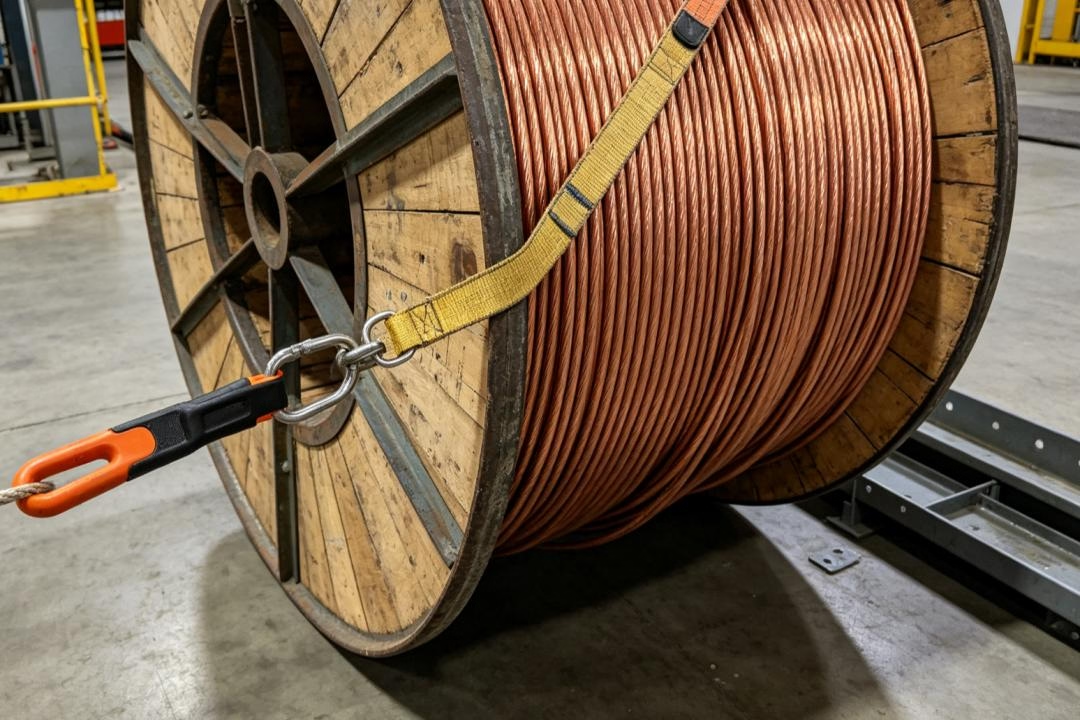
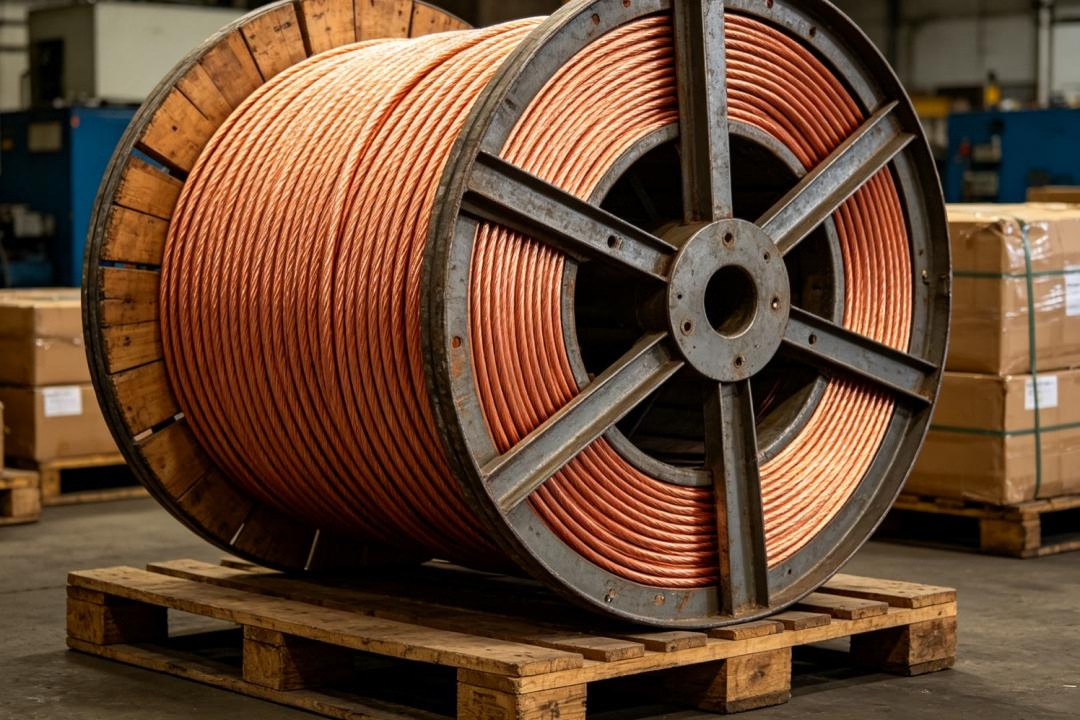
A Heavy Wooden Cable Reel Tightly Wound With Stranded Bare Copper Wire Inside An Industrial Warehouse. This Large Spool Illustrates The Substantial Mass Of Copper Cable. Heavy Copper Reels Demand Proper Rigging, Pulling Hardware And Mechanical Equipment For Safe Transportation And Installation, Highlighting The Critical Importance Of Calculating Copper Cable Weight Ahead Of Every Pull.
Cable weight directly affects shipping costs. Heavier cables cost more to transport, require stronger packaging, and may require special handling equipment.
Worker Safety
Manual handling of heavy cables is a leading cause of workplace injuries in the electrical industry. Knowing the weight of the cable you are handling helps you plan safe lifting procedures and avoid injuries.
Equipment Selection
The weight of a cable determines the type of pulling equipment, supports, and accessories required for installation. Choosing the wrong equipment because you underestimated cable weight can lead to delays, damage, and safety incidents.
The Density of Copper: Why It Is So Heavy
Copper has a density of approximately 8,900 kg/m³ (8.9 grams per cubic centimetre). By comparison, aluminium has a density of approximately 2,700 kg/m³. This means copper is more than three times heavier than aluminium for the same volume.
This density is what gives copper its excellent electrical conductivity—the atoms are packed tightly together, allowing electrons to flow freely. But it is also what makes copper cable so heavy.
The weight of a copper cable is determined by three primary factors:
Conductor size – Larger conductors contain more copper and weigh more
Length – Weight scales linearly with length
Insulation and jacketing – Additional layers add weight beyond the copper itself
Copper Cable Weight Tables
Bare Copper Conductors (Nexans Data)
The following table shows approximate net cable weights for bare copper conductors:
| Size (AWG/kcmil) | Strands | Diameter (mm) | Weight (kg/km) | Weight (lbs/kft) |
|---|---|---|---|---|
| 14 AWG | 1 | 1.63 | 18.5 | 12.4 |
| 12 AWG | 1 | 2.05 | 29.4 | 19.8 |
| 10 AWG | 1 | 2.59 | 46.8 | 31.4 |
| 8 AWG | 7 | 3.61 | 75.9 | 51.0 |
| 6 AWG | 7 | 4.55 | 121.0 | 81.1 |
| 4 AWG | 7 | 5.72 | 192.0 | 129.0 |
| 2 AWG | 7 | 7.19 | 305.0 | 205.0 |
| 1 AWG | 19 | 7.95 | 385.0 | 258.0 |
| 1/0 AWG | 19 | 8.94 | 485.0 | 325.0 |
| 2/0 AWG | 19 | 10.03 | 611.0 | 410.0 |
| 3/0 AWG | 19 | 11.25 | 771.0 | 518.0 |
| 4/0 AWG | 19 | 12.65 | 972.0 | 653.0 |
| 250 kcmil | 37 | 13.77 | 1,149.0 | 772.0 |
| 300 kcmil | 37 | 15.06 | 1,378.0 | 926.0 |
| 350 kcmil | 37 | 16.28 | 1,609.0 | 1,081.0 |
| 400 kcmil | 37 | 17.41 | 1,839.0 | 1,236.0 |
| 500 kcmil | 37 | 19.48 | 2,299.0 | 1,545.0 |
Source: Nexans Bare Copper Construction Characteristics Table
Bare Copper Cable (4/0 AWG Example)
A 4/0 AWG bare copper cable with 19 strands weighs approximately 653 pounds per 1,000 feet. For a 500-foot length, this is 326.5 pounds. For a 100-foot length, it is 65.3 pounds.
Armoured Cable Weight Examples
When insulation, jacketing, and armour are added, the weight increases significantly. Southwire’s Armorlite® Type MC Feeder Cable provides a clear example:
| Conductor Size | Conductors | Copper Weight (lbs/1000ft) | Overall Weight (lbs/1000ft) |
|---|---|---|---|
| 1 AWG | 3 | 864 | 1,147 |
| 1/0 AWG | 3 | 1,069 | 1,349 |
| 2/0 AWG | 3 | 1,326 | 1,637 |
| 3/0 AWG | 3 | 1,699 | 2,039 |
| 4/0 AWG | 3 | 2,109 | 2,536 |
| 250 kcmil | 3 | 2,469 | 2,975 |
| 350 kcmil | 3 | 3,603 | 4,205 |
Source: Southwire Armorlite® Type MC Feeder Cable
For a 4/0 AWG 3-conductor armoured cable, the copper alone weighs 2,109 pounds per 1,000 feet. The total cable weight, including insulation, armour, and fillers, is 2,536 pounds per 1,000 feet—more than a ton for a 1,000-foot reel.
Stranded Bare Copper Cable (Furse Data)
For stranded bare copper cable used in earthing and lightning protection applications:
| Cross-Section (mm²) | Stranding | Diameter (mm) | Weight per Metre (kg) |
|---|---|---|---|
| 16 mm² | 7/1.70 | 5.10 | 0.17 |
| 25 mm² | 7/2.14 | 6.42 | 0.23 |
| 35 mm² | 7/2.52 | 7.56 | 0.32 |
| 50 mm² | 19/1.78 | 8.90 | 0.43 |
| 70 mm² | 19/2.14 | 10.70 | 0.62 |
| 95 mm² | 19/2.52 | 12.60 | 0.86 |
| 120 mm² | 37/2.03 | 14.21 | 1.09 |
| 150 mm² | 37/2.25 | 15.75 | 1.33 |
| 185 mm² | 37/2.52 | 17.64 | 1.67 |
| 240 mm² | 61/2.25 | 20.25 | 2.20 |
| 300 mm² | 61/2.52 | 22.68 | 2.76 |
| 400 mm² | 61/2.85 | 25.65 | 3.53 |
Source: Furse Bare Stranded Copper Cable
How to Calculate Copper Cable Weight
If you need to estimate the weight of a copper cable that is not listed in a table, you can calculate it using the formula:
The Formula
Weight = Cross-Sectional Area × Density × Length
For copper:
Density of copper = 8,900 kg/m³ (or 8.9 g/cm³)
Step-by-Step Example
Problem: Calculate the weight of 100 metres of 50 mm² copper cable.
Step 1: Convert the cross-sectional area to square metres.
50 mm² = 50 × 10⁻⁶ m² = 0.00005 m²
Step 2: Multiply by the density.
0.00005 m² × 8,900 kg/m³ = 0.445 kg per metre
Step 3: Multiply by the length.
0.445 kg/m × 100 m = 44.5 kg
The copper conductor alone weighs approximately 44.5 kg for 100 metres. The total cable weight will be higher once insulation, jacketing, and any armour are added.
Quick Estimation Rule
A common rule of thumb for estimating copper cable weight is:
Weight (kg/km) ≈ 8.9 × Cross-Sectional Area (mm²)
For example:
50 mm²: 8.9 × 50 = 445 kg/km
95 mm²: 8.9 × 95 = 845.5 kg/km
150 mm²: 8.9 × 150 = 1,335 kg/km
This rule gives the weight of the copper conductor only. For the total cable weight, add the weight of insulation, jacketing, armour, and fillers.
Copper vs. Aluminium: The Weight Difference
One of the most significant differences between copper and aluminium cables is weight.
Density Comparison
Copper: 8,900 kg/m³
Aluminium: 2,700 kg/m³
Ratio: Copper is 3.3 times heavier than aluminium for the same volume
Practical Weight Comparison
A 240 mm² aluminium conductor weighs approximately 723 kg/km, while a 150 mm² copper conductor (with similar conductance) weighs around 1,341 kg/km.
Despite the increase in cable thickness when using aluminium, the weight reduction can reach 30–40 per cent, depending on the specific design. This weight advantage is why aluminium is often chosen for overhead transmission lines and applications where weight is a critical factor.
However, weight is not the only consideration. Copper’s superior conductivity means that for the same current-carrying capacity, a copper conductor can be significantly smaller—which reduces the overall cable diameter and can offset some of the weight advantage.
The Submarine Cable Advantage
In submarine cable installations, copper’s higher weight is actually an advantage. Heavier cables sink more quickly and reliably into the seabed during burial operations. They are also more stable once laid on the seabed, resisting movement from tidal currents. In both scenarios, copper’s significantly higher specific weight (by a factor of three times compared to aluminium) leads to a more efficient cable-laying process and greater stability of cables.
Factors That Affect Total Cable Weight
Conductor Size
The single biggest factor affecting cable weight is the conductor size. Larger conductors contain more copper and weigh more. The difference between 14 AWG and 4/0 AWG is dramatic—from 12.4 lbs/kft to 653 lbs/kft.
Insulation Type
Different insulation materials have different densities. PVC insulation adds weight, while XLPE and other materials may add more or less depending on their thickness and density.
Jacketing and Sheathing
Outer jackets add significant weight, particularly for cables designed for outdoor or industrial use. Thicker jackets provide more protection but add more weight.
Armour
Armoured cables are significantly heavier than unarmoured cables. Steel wire armour (SWA) adds substantial weight, while aluminium interlocked armour (AIA) adds less but still contributes.
Fillers and Bedding
Many multi-conductor cables include fillers to maintain the cable’s round shape and bedding layers between the conductors and the armour. These add to the total weight.
Practical Tips for Managing Copper Cable Weight
1. Plan Your Pull
Before you start a cable pull, calculate the total weight of the cable you will be handling. For long pulls, consider using mechanical pulling equipment rather than manual labour.
2. Check Tray Load Ratings
Cable trays have maximum load ratings. Ensure that the total weight of the cables in the tray does not exceed the tray’s rated capacity. Underestimating cable weight can lead to sagging trays and structural failures.
3. Use Proper Lifting Equipment
For heavy reels and long cable lengths, use appropriate lifting equipment. A 1,000-foot reel of 4/0 AWG armoured cable can weigh over 2,500 pounds—far too heavy for manual handling.
4. Consider Weight in Your Design
When designing a cable installation, consider the weight of the cables in your structural calculations. Overhead supports, building structures, and cable trays must all be designed to support the weight of the cables they carry.
5. Use Weight Tables for Estimating
Keep a reference table of cable weights handy for estimating purposes. The tables in this article provide a good starting point for common cable sizes.
Frequently Asked Questions
Q: How much does 4/0 AWG copper cable weigh per foot?
A: A 4/0 AWG bare copper cable weighs approximately 0.653 pounds per foot. A 100-foot length weighs about 65.3 pounds.
Q: How much does 12 AWG copper cable weigh per foot?
A: 12 AWG bare copper cable weighs approximately 19.8 pounds per 1,000 feet, or about 0.0198 pounds per foot.
Q: Is copper cable heavier than aluminium cable?
A: Yes. Copper is approximately 3.3 times heavier than aluminium for the same volume. However, for the same current-carrying capacity, a copper conductor can be smaller, which reduces the overall cable diameter.
Q: How do I calculate the weight of a copper cable?
A: Use the formula: Weight = Cross-Sectional Area × Density × Length. The density of copper is 8,900 kg/m³. For a quick estimate, use Weight (kg/km) ≈ 8.9 × Cross-Sectional Area (mm²).
Q: Why does copper cable weight matter?
A: Cable weight affects installation costs, structural loads, shipping costs, worker safety, and equipment selection. Underestimating cable weight can lead to safety hazards and project delays.
Q: Where can I find official copper cable weight data?
A: Official weight data is available from manufacturers such as Southwire, Nexans, and Prysmian. The Nexans Bare Copper Construction Characteristics Table provides detailed weight data for bare copper conductors. Southwire’s cable specification sheets also include weight information for their products.
Conclusion
Copper cable weight is not just a number on a specification sheet. It is a critical factor that affects every aspect of an electrical installation—from design and procurement to installation and maintenance.
The numbers are clear:
A 4/0 AWG bare copper cable weighs 653 pounds per 1,000 feet
A 4/0 AWG 3-conductor armoured cable weighs 2,536 pounds per 1,000 feet
Copper is 3.3 times heavier than aluminium for the same volume
A 150 mm² copper conductor weighs approximately 1,341 kg/km
Understanding these numbers helps you plan safer installations, choose the right equipment, and avoid costly mistakes. When you know how much your copper cable weighs, you can pull it safely, support it properly, and install it efficiently.
When you choose copper cable, you are not just choosing a conductor—you are choosing a material that is heavy, durable, and reliable. And knowing its weight is the first step to working with it safely.
References
Nexans – Bare Copper Construction Characteristics Table
Southwire – Armorlite® Type MC Feeder Cable Specifications
Elliott Electric Supply – Bare Copper Cable, 4/0 AWG, 19 Strands
Leonardo Energy – The Weight Advantage of Copper in Submarine Cables
HELUKABEL – CCA Conductors Instead of Aluminium or Copper
Furse – Bare Stranded Copper Cable Conductors
This guide is for informational purposes only. Always consult the latest manufacturer specifications and work with qualified professionals for electrical installations.