 Minxing Cable
 Jinhuanyu Cable
 Jinlongyu Cable
 Guangdong Cable
 Zhujiang Wire & Cable



Introduction
You have spent thousands of dollars on high-quality copper cable. You have carefully calculated the ampacity, selected the right insulation, and followed every code requirement. Then, you reach for the cheapest cable gland you can find.
That is a mistake that could cost you far more than the few dollars you saved.
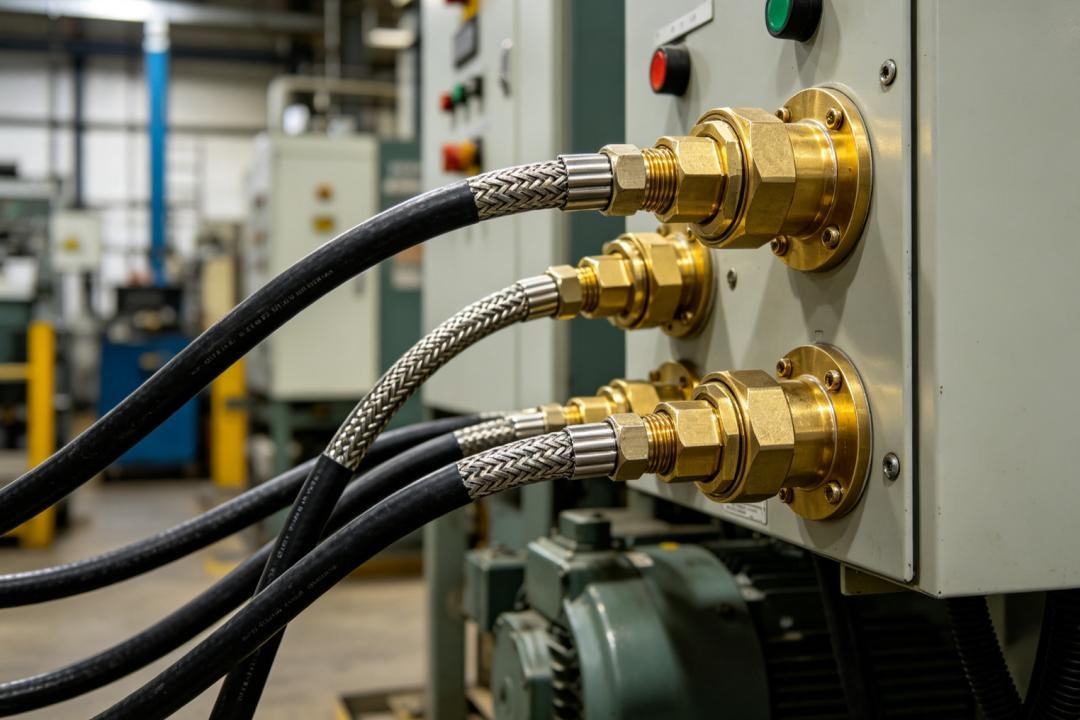
A copper cable gland is a mechanical fitting used to secure the end of a cable into electrical equipment. It maintains the enclosure’s integrity, provides strain relief, and ensures earth continuity where required. It sounds simple. But choosing the wrong gland—or installing it incorrectly—can lead to cable failure, equipment damage, electrical fires, and even loss of life.
The global cable glands market was valued at USD 2.06 billion in 2025 and is expected to reach USD 3.20 billion by 2034, growing at a CAGR of 4.84%. With hundreds of millions of glands installed worldwide every year, the margin for error is surprisingly large.
This guide explains what copper cable glands are, why they matter, how to select the right one, and what happens when you get it wrong.
What Is a Copper Cable Gland?
A cable gland (also known as a cable connector or cable fitting) is a device designed to attach and secure the end of an electrical cable to equipment. It provides three essential functions:
Mechanical retention – Secures the cable so that pulling or twisting forces do not damage the internal connections.
Sealing – Prevents the ingress of dust, moisture, gases, and other contaminants into the enclosure.
Earthing/grounding – For armoured cables, the gland provides a path for fault currents to safely reach earth.
A copper cable gland is a gland made from copper or a copper-based alloy—most commonly brass. Brass is an alloy of copper and zinc, and it offers an exceptional combination of properties that make it the preferred material for the vast majority of industrial cable glands.
Why Brass (Copper Alloy) Dominates the Cable Gland Market
Brass cable glands are the industry standard for good reason:
1. Excellent Electrical Conductivity
Brass provides good electrical conductivity. This is critical for maintaining earth continuity in armoured cable installations. When a fault occurs, the gland must carry fault current safely to ground. Poor conductivity means higher resistance, more heat, and a greater risk of failure.
2. High Mechanical Strength
Brass has high mechanical strength, high hardness, and strong chemical corrosion resistance. It can withstand the physical stresses of installation and the harsh conditions of industrial environments.
3. Exceptional Wear Resistance
Brass has strong wear resistance. In applications where cables are frequently connected and disconnected, or where vibration is present, brass glands maintain their integrity far longer than softer materials.
4. Corrosion Resistance
Brass is highly resistant to corrosion. For outdoor, marine, and industrial environments, brass cable glands provide long-term reliability that aluminium or plastic alternatives cannot match.
5. Wide Temperature Range
Brass cable glands can operate across a broad temperature range, from extreme cold to high heat, without losing their mechanical properties.
The Difference Between Copper and Brass
It is worth noting that most “copper cable glands” on the market are actually made from brass (a copper-zinc alloy), not pure copper. Pure copper is too soft for the mechanical demands of a cable gland. Brass retains copper’s excellent conductivity while adding the strength, hardness, and wear resistance needed for a durable mechanical fitting.
Types of Copper Cable Glands
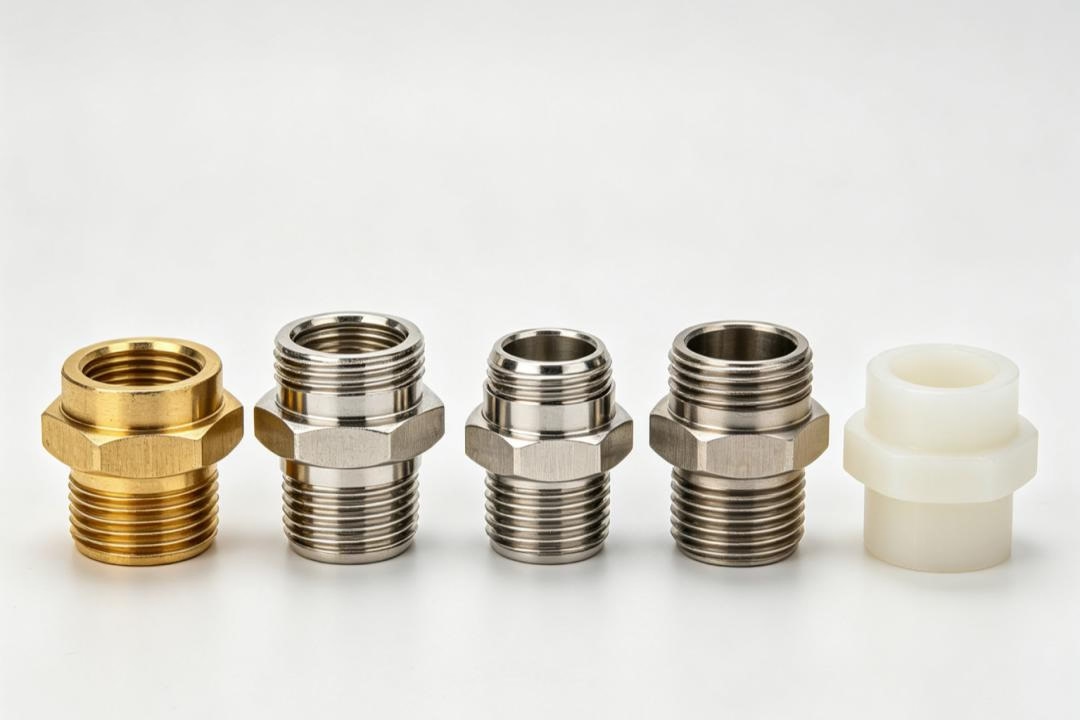
Studio Product Shot Displaying Cable Glands Made From Different Materials: Brass, Stainless Steel And Nylon. Each Material Delivers Distinct Conductivity, Mechanical Strength And Corrosion Resistance, Allowing Electrical Engineers To Select Appropriate Cable Glands For Indoor, Outdoor, Marine And Industrial Operating Environments.
Cable glands come in many varieties, each designed for specific cable types and installation conditions. Understanding the differences is essential for selecting the right gland.
By Cable Type
1. Single-Compression Glands (for Unarmoured Cables)
Single-compression glands are designed for unarmoured cables. They provide a seal on the outer sheath of the cable and offer strain relief. They are typically used in indoor, protected locations.
2. Double-Compression Glands (for Armoured Cables)
Double-compression glands are used for armoured cables such as SWA (Steel Wire Armoured) or AWA (Aluminium Wire Armoured) cables. They provide two seals: one on the inner bedding and one on the outer sheath. They also include a mechanism for clamping the armour to ensure earth continuity. Generally, double-compression glands are required for outdoor locations.
3. CW Glands (for Armoured Cables)
CW glands offer a seal on the cable’s outer sheath and include armour clamping. They are designed for steel wire armoured cables and provide both mechanical retention and earth continuity.
4. AZ/AZF Glands (for Braid/Tape Armoured Cables)
These glands are suitable for use with braid or tape armoured cables when terminated inside an enclosure. They are commonly used with flexible cables and braided shields.
By Material
1. Brass Cable Glands
The most common type, offering an optimal balance of conductivity, strength, and corrosion resistance.
2. Nickel-Plated Brass Cable Glands
Brass glands with an additional nickel plating layer. The nickel plating improves corrosion resistance, making them suitable for marine and highly corrosive environments.
3. Stainless Steel Cable Glands
Used where extreme corrosion resistance is required, such as in chemical plants or offshore installations. Stainless steel is stronger than brass but more expensive and less conductive.
4. Aluminium Cable Glands
Lighter than brass and suitable for applications where weight is a concern. However, aluminium has lower strength and is more prone to aging and dimensional changes.
5. Plastic/Nylon Cable Glands
Non-conductive and lighter than metal glands. They are used in indoor panels and control cabinets where corrosion resistance is more important than mechanical strength.
By Application Environment
1. Standard Duty Glands
For general-purpose indoor applications where environmental conditions are mild.
2. Heavy-Duty Glands
For industrial environments where cables are subject to mechanical stress, vibration, or harsh conditions.
3. Hazardous Area Glands (Ex d / Ex e)
Certified for use in explosive atmospheres. For cables at least 3 metres in length, use certified Ex d or Ex d/Ex e dual-certified types.
4. EMC Glands
Designed to maintain electromagnetic compatibility by providing a low-impedance path to ground for cable shields.
5. Marine-Grade Glands
For use with armoured marine shipboard jacketed or non-jacketed cable. These glands are designed to withstand the harsh conditions of marine environments.
Standards and Certifications
Copper cable glands must meet rigorous standards to ensure safety and performance.
International Standards
BS EN 62444 / IEC 62444
This is the primary international standard covering cable glands for electrical installations. It defines requirements and tests for the construction and performance of cable glands. It covers classification, marking, and documentation. The standard supersedes BS EN 50262:1999 and is identical to IEC 62444. It addresses mechanical strength, sealing, and strain relief performance.
IEC 60529
This standard defines Ingress Protection (IP) ratings, which quantify a cable gland’s resistance to dirt and moisture. An IP code has two digits: the first digit (0-6) indicates solid particle protection, and the second digit (0-9) indicates liquid ingress protection.
CENELEC EN 50014-50019
These standards apply to cable glands used in hazardous areas.
Regional Standards
North America
In North America, cable glands are less commonly used than conduit systems. However, when they are used, they must comply with UL standards. UL 514B covers cable glands for general environments, while UL 2225 applies to glands used in hazardous locations. Fittings suitable for wet locations are identified by a “Wet Location” marking on the carton.
United Kingdom
BS 6121 and BS EN 50262 are referenced for industrial cable glands.
South Africa
SANS 1213:2020 specifies requirements for cable glands manufactured from brass and then nickel-plated.
IP Ratings: What They Mean
The IP rating of a cable gland denotes its ingress protection level:
| IP Rating | Meaning |
|---|---|
| IP54 | Protected against dust ingress and splashing water. Suitable for indoor control cabinets. |
| IP64 | Dust-tight and protected against splashing water. |
| IP68 | Totally dust-tight and capable of continuous submersion in water. |
For hazardous areas, Ex-certified products need to meet a minimum protection level of IP54 (or IP64 if certified for use with dusts).
How to Select the Right Copper Cable Gland
Selecting the correct cable gland requires careful consideration of multiple factors.
Step 1: Identify the Cable Type
Is the cable armoured or unarmoured? If armoured, what type of armour does it have—steel wire, aluminium wire, braid, or tape? Different cable types require different gland designs.
Step 2: Measure the Cable Diameter
Cable gland size is based on the nominal dimensions of overall diameter and armour diameter. You need to know:
The overall cable diameter (the outer sheath diameter)
The inner sheath diameter (for armoured cables)
The armour diameter (for armoured cables)
Cable manufacturers provide tolerance on these dimensions. If in doubt, test-fit a gland before committing to a large purchase.
Step 3: Select the Thread Type
Cable glands are available with different thread types:
Metric threads – The European standard, ranging from 6 mm to 110 mm
PG threads – German standard conduit threads
NPT threads – National Pipe Thread, used in North America
ISO metric threads – Common in international applications
The thread type must match the thread on the equipment enclosure or conduit.
Step 4: Choose the Material
For most industrial applications, brass is the default choice. Choose nickel-plated brass for marine or highly corrosive environments. Choose stainless steel for extreme corrosion resistance. Choose aluminium where weight is a critical factor. Choose plastic/nylon for non-conductive, lightweight indoor applications.
Step 5: Determine the IP Rating Requirement
The gland’s IP rating must meet or exceed the IP rating of the enclosure it is fitted to. As a rule, entry devices shall meet the minimum degree of protection (IP Code) for the application. For outdoor or wet locations, choose IP66 or IP68.
Step 6: Consider the Installation Environment
Indoor, protected locations: Single-compression brass glands are usually sufficient.
Outdoor locations: Double-compression glands are required.
Hazardous areas: Ex d or Ex e certified glands are mandatory.
Marine environments: Use marine-grade glands with enhanced corrosion protection.
Step 7: Verify Compliance
Ensure the gland meets all applicable standards: BS EN 62444, IEC 62444, UL, CSA, or local equivalent.
Installation Best Practices
Even the best copper cable gland will fail if installed incorrectly. Follow these best practices:
1. Strip the Cable Correctly
For armoured cables, strip back the outer sheath to expose the armour. Strip the inner bedding to expose the conductors. The armour must be clean and free of debris.
2. Use the Correct Tools
Use the correct spanners or wrenches for the gland size. Over-tightening can damage the gland or the cable. Under-tightening can compromise the seal and earth continuity.
3. Ensure Proper Earth Continuity
For armoured cables, the gland must make proper contact with the armour. This ensures that fault currents have a low-impedance path to ground. Use the correct armour clamping ring and ensure it is tight.
4. Apply the Correct Torque
Follow the manufacturer’s torque specifications. Over-tightening can strip threads or crush the cable. Under-tightening can compromise the seal.
5. Use the Correct Seal
Ensure the gland’s sealing ring is correctly positioned and is the correct size for the cable diameter. A poor seal allows moisture and contaminants to enter the enclosure.
6. For Hazardous Areas
In hazardous areas, only use certified glands and follow the manufacturer’s installation instructions precisely. For cables at least 3 metres in length, use certified Ex d or Ex d/Ex e dual-certified types.
Common Mistakes to Avoid
Mistake 1: Using Single-Compression Glands Outdoors
Single-compression glands are for indoor, protected locations. Outdoor locations require double-compression glands.
Mistake 2: Choosing the Wrong Size
A gland that is too small will not fit the cable. A gland that is too large will not provide a proper seal or strain relief. Always measure the cable diameter carefully.
Mistake 3: Ignoring IP Ratings
Using a gland with an inadequate IP rating in a wet or dusty environment invites failure. The gland must meet or exceed the enclosure’s IP rating.
Mistake 4: Using the Wrong Material
In corrosive environments, a standard brass gland may not last. Use nickel-plated brass or stainless steel.
Mistake 5: Overlooking Earth Continuity
For armoured cables, the gland is the primary means of earth continuity. A poor connection can leave the armour unearthed, creating a serious shock hazard.
Mistake 6: Installing in Conduit Without Proper Derating
Cable glands are not designed to be installed inside conduit. The heat dissipation is unknown, and the ampacity cannot be determined. Install glands in open air or enclosures as designed.
The Cost of Getting It Wrong
A failed cable gland is not a minor inconvenience. It can lead to:
Cable pull-out: The cable detaches from the equipment, causing loss of power or signal.
Water ingress: Moisture enters the enclosure, damaging sensitive electronics and causing short circuits.
Loss of earth continuity: The armour becomes unearthed, creating a shock hazard.
Equipment failure: Damage to motors, drives, controllers, or other expensive equipment.
Fire: Overheating due to poor connections can ignite surrounding materials.
Legal liability: Non-compliance with codes and standards can result in fines, lawsuits, and insurance claims.
The cost of a quality brass cable gland is negligible compared to the cost of a failure.
Frequently Asked Questions
Q: What is a copper cable gland?
A: A copper cable gland—typically made from brass—is a mechanical fitting used to secure the end of a cable into electrical equipment, providing strain relief, sealing, and earth continuity.
Q: Why are most copper cable glands made from brass?
A: Brass is a copper-zinc alloy that offers excellent conductivity, high mechanical strength, strong wear resistance, and good corrosion resistance. Pure copper is too soft for the mechanical demands of a cable gland.
Q: What is the difference between single-compression and double-compression glands?
A: Single-compression glands are for unarmoured cables in indoor, protected locations. Double-compression glands are for armoured cables and outdoor locations.
Q: What IP rating do I need for a cable gland?
A: The gland’s IP rating must meet or exceed the IP rating of the enclosure it is fitted to. For outdoor or wet locations, choose IP66 or IP68.
Q: What standards apply to cable glands?
A: The primary international standard is BS EN 62444 / IEC 62444. In North America, UL standards apply. For hazardous areas, Ex d or Ex e certification is required.
Q: Can I use a brass cable gland outdoors?
A: Yes, but use double-compression glands for armoured cables and outdoor locations. For marine or highly corrosive environments, choose nickel-plated brass or stainless steel.
Q: Where can I find official cable gland standards?
A: Official standards are published by IEC (IEC 62444), BSI (BS EN 62444), UL, and CSA. The IEC website (www.iec.ch) and BSI website (www.bsigroup.com) provide access to these standards.
Conclusion
The humble copper cable gland is one of the most overlooked components in electrical installations. Yet it plays a critical role in safety, reliability, and performance.
A properly selected and installed brass cable gland provides:
Secure cable retention – Prevents pull-out and damage
Effective sealing – Keeps moisture and contaminants out
Reliable earth continuity – Protects against electric shock
Long service life – Withstands harsh conditions for decades
The global cable glands market is worth over USD 2 billion and growing. With hundreds of millions of glands installed worldwide, the stakes are high. Getting it wrong can cost far more than the few dollars saved on a cheap gland.
When you choose a copper cable gland, you are not just buying a fitting—you are investing in safety, reliability, and peace of mind.
References
BS EN 62444:2013 – Cable glands for electrical installations
IEC 60529 – Degrees of protection provided by enclosures (IP Code)
UL 514B – Fittings for Conduit, Tubing, and Cable
UL 2225 – Cables and Cable Fittings for Use in Hazardous Locations
Research and Markets – Cable Glands Market Report 2025-2034
Various industry sources including Eland Cables, Expert Electrical, Batt Cables, and Hawke International
This guide is for informational purposes only. Always consult the latest edition of applicable standards and work with qualified professionals for electrical installations.