 Minxing Cable
 Jinhuanyu Cable
 Jinlongyu Cable
 Guangdong Cable
 Zhujiang Wire & Cable




Copper Welding Cables Introduction
You are in the middle of a critical weld. The arc is stable. The bead is forming perfectly. Then, without warning, the arc falters. The weld pool sputters. You check the machine—everything is fine. You check the gas—still flowing. Then you realise: your cable is the problem.
The conductor material in your welding cable is not just a detail. It is the difference between a smooth, reliable weld and a frustrating, inconsistent one. It is the difference between a cable that lasts for years and one that fails in months. It is the difference between safety and risk.
Here is the uncomfortable truth: not all welding cables are created equal. And when it comes to conductor material, copper wins. Every single time.
This guide explains why copper is undeniably superior to aluminum for welding cables—backed by physics, industry standards, and real-world performance data. If you are choosing welding cables for your shop, your site, or your business, this is the information you need.
The Numbers That Matter: Conductivity and Ampacity
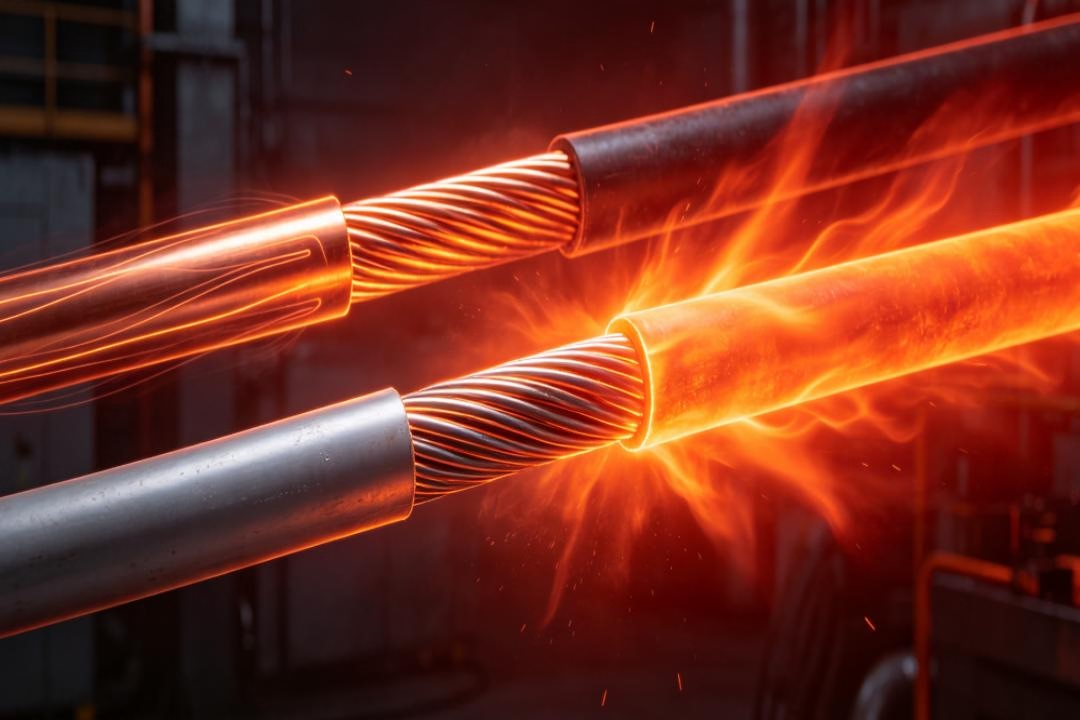
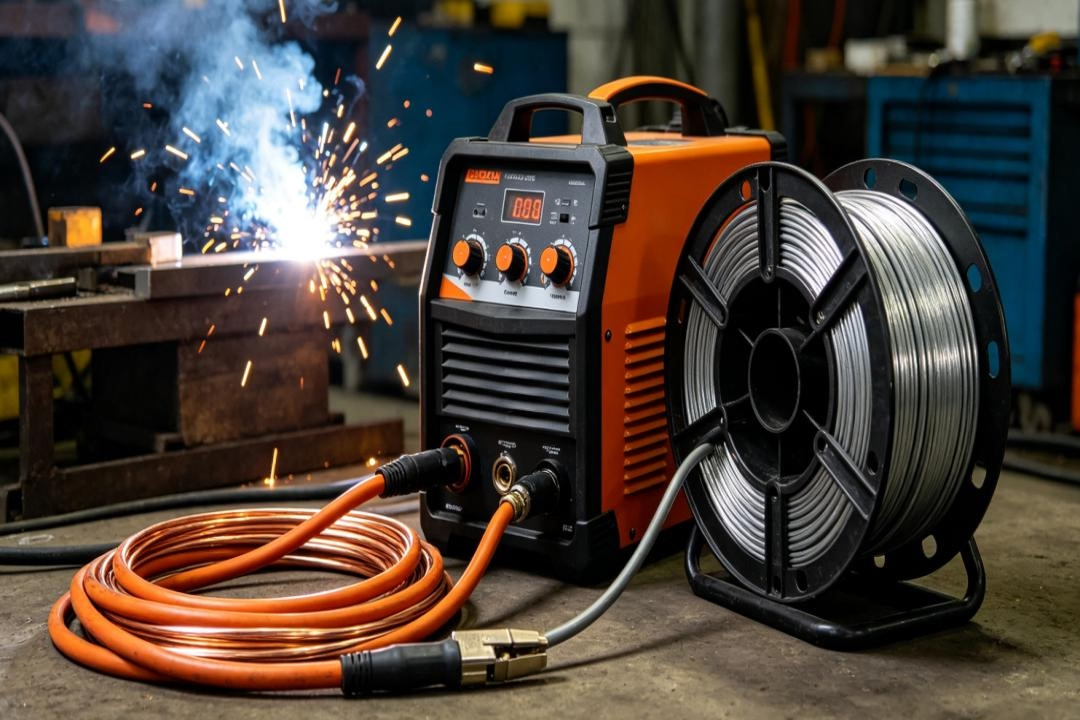
Industrial Technical Visualization Comparing Copper And Aluminum Stranded Conductors. Copper Transmits Electric Current Smoothly With Minimal Heat Output. Aluminum Creates Intense Resistive Heating Under Equal Current Load, Demonstrating Higher Resistance, Wasted Energy And Elevated Safety Risks For Welding Applications.
The most fundamental difference between copper and aluminum is electrical conductivity.
Copper has a conductivity of approximately 5.8×10⁷ S/m, while aluminum achieves only about 3.5×10⁷ S/m. This means copper is roughly 64% more conductive than aluminum for the same cross-sectional area.
What does this mean in practice?
Current-Carrying Capacity
An aluminum conductor has a roughly 40% lower current-carrying capacity than a copper conductor of equivalent size. To match the ampacity of a copper cable, an aluminum cable must be 50–60% larger in diameter.
For equivalent conductivity, the cross-section of an aluminum conductor must be 1.6 times larger than that of a copper conductor.
Consider a practical example: a 4 AWG copper welding cable is rated for 85 amps at 75°C. To achieve the same ampacity with aluminum, you would need 2 AWG aluminum—a physically larger, heavier, and more expensive-to-install cable.
Heat Generation
Higher resistance means more heat. Since aluminum has roughly 60% higher resistance than copper for the same cross-section, it generates significantly more heat during welding. This heat is not just wasted energy—it is a safety hazard. Overheated cables can damage insulation, create fire risks, and reduce the lifespan of your equipment.
Energy Efficiency
A copper core can reduce energy loss by 15% compared to aluminum alternatives. Over thousands of welding hours, that 15% adds up to real money—and real heat that stays out of your cable and stays in your weld.
The Size and Weight Trap: Bigger Is Not Better
Aluminum is lighter than copper—about three times lighter. This is aluminum’s primary advantage. For long overhead runs or applications where weight is absolutely critical, aluminum’s lightness can be an asset.
But weight is not everything.
To carry the same current as a copper cable, an aluminum cable must be much larger. This larger diameter means:
Bulkier cables that are harder to route through tight spaces
Heavier overall weight than you might expect (the larger size offsets some of the weight advantage)
More expensive installation due to larger conduits and heavier handling
Less flexible cables that resist bending and coiling
The weight advantage of aluminum is real, but it comes at the cost of larger, bulkier, less manageable cables. In most welding environments—where flexibility and ease of handling are paramount—copper’s smaller size and superior flexibility are far more valuable than aluminum’s weight savings.
Flexibility: The Welder’s Best Friend
Welding is not a stationary activity. Welders move. They reach. They bend. They work in tight spaces, around corners, and in awkward positions. Their cables must move with them.
Copper is significantly more flexible than aluminum.
Because copper has higher ductility and malleability than aluminum, it can bend easily during use and be maneuvered through tight corners and constricted areas without breaking or cracking. Copper’s flexibility allows it to move with the welder, reducing wrist fatigue and improving ergonomic safety.
Aluminum, by contrast, is more brittle. It is more prone to cracking and failure when subjected to repeated bending, vibration, or mechanical stress. Even finely stranded aluminum is typically less ductile than copper, so in very high-flex, daily-coil applications, copper often outlasts aluminum.
Multi-strand copper cables not only have a larger cross-sectional area but also reduce the “skin effect” (where current flows on the outer surface of the conductor). This design also makes the cable flexible and easier to handle.
For a welder working a full shift, the difference between a flexible copper cable and a stiff aluminum cable is not just a matter of convenience—it is a matter of fatigue, safety, and productivity.
Durability and Longevity: The Long Game
Welding cables take a beating. They are dragged across shop floors. They are stepped on. They are coiled and uncoiled thousands of times. They are exposed to heat, sparks, oil, and mechanical stress.
Copper is simply more durable.
Mechanical Strength
Copper has roughly 40% better tensile strength than aluminum. This means copper cables are less likely to break during installation or use. Copper conductors can withstand higher pulling stresses without necking or breaking.
Fatigue Resistance
Copper can withstand larger vibration amplitudes and for much longer than aluminum conductors without cracking or breaking. In high-cycle fatigue applications, copper outperforms aluminum by a significant margin.
Corrosion Resistance
Copper is resistant to corrosion, making it well suited for a wide range of environments, including harsh industrial settings. Aluminum is more susceptible to corrosion and requires special precautions in corrosive environments, such as special coatings or alloying.
aluminum also forms a hard oxide layer that is electrically insulating. This oxide layer can compromise connections over time, increasing resistance and creating hot spots. Copper’s oxide, by contrast, remains conductive.
Heat Resistance
Since aluminum generates more heat due to its higher resistance, it is more likely to overheat during heavy-duty tasks. Copper handles heat much better, ensuring a safer and more efficient welding process.
The Termination Problem: Where Aluminum Fails Most
Perhaps the most critical weakness of aluminum welding cables is termination.
aluminium forms a hard oxide layer that is electrically insulating; terminations must be aluminium-rated (or use copper-clad transition pieces) and be handled with anti-oxidant compounds and correct crimping procedures.
Terminations are where many aluminium installations fail.
For any aluminum welding cable installation:
Use lugs and connectors rated for aluminium
Clean contact surfaces
Use approved anti-oxidant paste
Follow torque/crimp specs from the lug and cable makers
Consider factory-terminated leads if you lack certified crimp tools or trained technicians
Copper is simply easier to terminate. Because copper is more malleable than aluminium, it is generally easier to terminate and join. Copper forms reliable, oxidation-resistant gas-tight crimps.
A poor termination on a copper cable is a problem. A poor termination on an aluminium cable is a disaster. The combination of aluminium’s insulating oxide layer, its tendency to creep under pressure, and its higher thermal expansion coefficient makes aluminium terminations a persistent source of failure in welding applications.
The Real-World Cost Comparison
Aluminium is cheaper than copper on a per-kilogram basis. Copper can cost roughly twice as much.
But cost per kilogram is the wrong metric.
When you factor in the larger size required for aluminium to match copper’s ampacity, the price advantage shrinks significantly. When you factor in the shorter lifespan of aluminium cables in demanding welding environments, the advantage shrinks further. When you factor in the downtime caused by cable failures, the advantage disappears entirely.
A copper welding cable may cost more upfront, but it will:
Last longer in demanding environments
Perform better with less voltage drop and heat generation
Require fewer replacements over the life of your equipment
Reduce downtime from cable failures
Improve weld quality with more stable arc characteristics
For professionals looking for efficiency, safety, and long-term performance, copper cables are the clear winner.
When Does Aluminum Make Sense?
To be fair, there are situations where aluminum welding cables are a reasonable choice:
Light-duty, low-demand applications where heat generation is not a concern
Cost-sensitive projects with tight budgets
Long overhead runs where weight savings are critical
Temporary installations where the cable will not be used for years
For these applications, aluminum can be a viable option.
But for professional welding—where quality, reliability, safety, and productivity matter—copper is the clear and obvious choice.
Summary: Copper vs. Aluminum for Welding Cables
| Property | Copper | Aluminum |
|---|---|---|
| Conductivity (S/m) | ~5.8×10⁷ | ~3.5×10⁷ |
| Relative Conductivity | 100% | ~61-64% |
| Ampacity (same size) | Higher | ~40% lower |
| Size for same ampacity | Smaller | 50-60% larger |
| Flexibility | Excellent | Poorer |
| Tensile Strength | ~40% better | Lower |
| Fatigue Resistance | Superior | Inferior |
| Corrosion Resistance | Excellent | Requires precautions |
| Termination | Easy, reliable | Requires special care |
| Heat Generation | Lower | Higher |
| Melting Point | 1,083°C | 660°C |
| Cost | Higher | Lower |
| Lifespan | Longer | Shorter |
Conclusion
Copper welding cables outperform aluminum in almost every critical area—conductivity, heat resistance, flexibility, and current capacity.
The physics are clear. The data is clear. The real-world experience of welders around the world is clear.
Yes, aluminum is cheaper and lighter. But these advantages come with significant tradeoffs: higher resistance, more heat, larger cables, less flexibility, poorer durability, and termination problems.
For a professional welder, these tradeoffs are not acceptable. The 15% energy loss, the 40% lower ampacity, the brittle conductor that cracks under repeated bending, the termination that fails under load—these are not minor inconveniences. They are barriers to productivity, quality, and safety.
Copper welding cables are an investment in your work. They deliver the performance, reliability, and safety that professional welding demands. They are the standard for a reason.
When you choose copper, you choose:
Superior conductivity for stable arcs and efficient power transfer
Higher ampacity for the same cable size
Greater flexibility for easier handling and less fatigue
Better durability for longer cable life
Reliable terminations for consistent performance
Lower heat generation for safer operation
Don’t let a cheaper cable compromise your work. Choose copper. Every time.
References
Tano Cable – Differences between welding cables with pure copper wire conductors and copper-clad aluminum conductors
WHX Cable – Choosing the Best: aluminum or Copper for Welding Cables
Hbhonglincable – What is an aluminum welding cable?
WeldWiki – What Are Welding Cables Made Of
WireAndCableTips – What’s the difference between copper and aluminum industrial cable?
Design World Online – What’s the difference between copper and aluminum industrial cable?
Leonardo Energy – A Comparative Evaluation of Copper and Aluminium Wires and Cables
Various engineering reference sites including AWS, IEC, and industry publications
This guide is for informational purposes only. Always consult the latest standards and work with qualified professionals for welding equipment selection and installation.