
 Minxing Cable
 Jinhuanyu Cable
 Jinlongyu Cable
 Guangdong Cable
 Zhujiang Wire & Cable



Aluminum vs. Copper in Cables Introduction
For decades, copper has reigned as the undisputed king of electrical conductors. Its superior conductivity, reliability, and proven track record made it the default choice for everything from residential wiring to industrial power distribution. But today, that dominance is being challenged.
Record-high copper prices—touching nearly $15,000 per metric ton in early 2026—have pushed the copper-to-aluminum price ratio to historic levels. In December 2025, the ratio reached 4.49, the highest since 2003. With the ratio now hovering around 4.2, a fundamental question confronts engineers, contractors, and procurement professionals alike:
Just how risky is it to substitute aluminum for copper in cable applications?
This article presents a comprehensive, data-driven Substitution Risk Scale—from 1 to 100—to help you evaluate when aluminum makes sense, when it doesn’t, and where the real dangers lie.
The Economic Driver: Why Substitution Is Happening Now
The primary catalyst for aluminum substitution is simple: cost.
Global copper prices have surged dramatically. The copper-to-aluminum price ratio has a long-run average of approximately 3.7, meaning a pound of copper has traditionally been 3.7 times more expensive than aluminum. Today, that ratio sits at approximately 4.2 to 4.4—well above the widely recognized “tipping point” of 3.5 identified by major manufacturers like Nexans, the world’s second-largest cable producer.
“When copper reaches 3.5 times the price of aluminum, manufacturers start buying aluminum. The ratio is now 4.2.”
— Nexans executive
The economic logic is compelling. Aluminum costs roughly one-third of copper per unit weight. For underground cable projects, where conductor materials can account for 30–50% of total project costs, switching to aluminum alloy conductors can reduce cable costs by 30–50%. Even accounting for the larger cross-sectional area required, the savings are substantial.
According to J.P. Morgan, aluminum is expected to displace approximately 2% of global copper consumption in 2026, rising to 6% by 2030—a compound annual growth rate of approximately 31.6%.
Material Properties: The Technical Reality
Before we can assess substitution risk, we must understand the fundamental material differences.
Conductivity
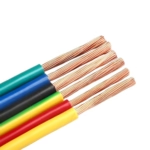
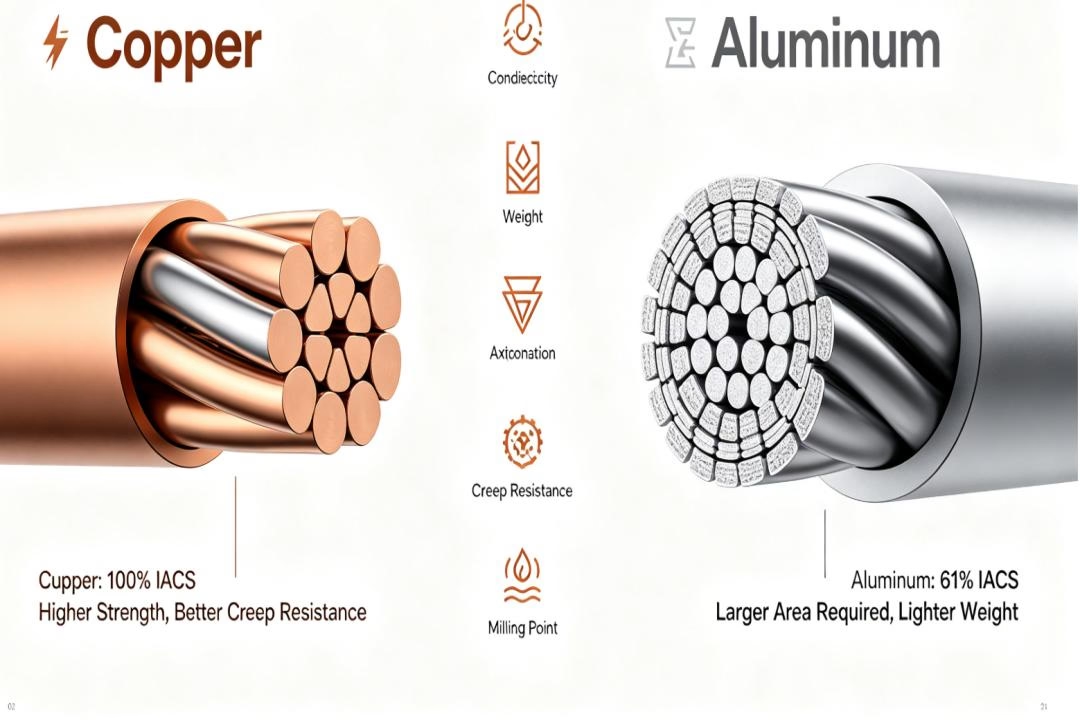
Copper sets the international standard at 100% IACS (International Annealed Copper Standard). Aluminum achieves only approximately 61% of copper’s conductivity. To carry the same current, an aluminum conductor must have a cross-sectional area roughly 1.5 to 1.6 times larger than copper.
This has significant implications:
Space constraints: In crowded conduits or compact equipment, the larger aluminum conductor may not fit.
Termination compatibility: Larger conductors require different connectors and lugs.
Voltage drop: For equivalent ampacity, aluminum’s higher resistance means longer runs suffer more voltage drop.
Weight
Aluminum is approximately one-third the density of copper (2.7 g/cm³ vs. 8.96 g/cm³). This means aluminum conductors are about 50% lighter than their copper equivalents.
This advantage is substantial for:
Overhead transmission lines
Long-distance cable pulls
Weight-sensitive applications like electric vehicles
Reducing transportation and installation costs
Thermal Expansion
Aluminum’s coefficient of thermal expansion is significantly higher than copper’s. This means aluminum expands and contracts more with temperature changes. Over time, these expansion/contraction cycles can loosen connections, increasing resistance and creating hot spots.
Oxidation
Aluminum forms an insulating oxide layer almost instantly when exposed to air. This oxide is highly resistive. If not properly managed during termination—using anti-oxidant compounds and specialized connectors—it creates poor connections that overheat.
Creep Resistance
Aluminum exhibits poorer creep resistance than copper. Under sustained pressure at connection points, aluminum deforms over time, loosening connections and increasing resistance.
Melting Point
Copper melts at 1,080°C, while aluminum melts at just 660°C. For fire-resistant applications requiring cables to maintain circuit integrity during a fire (e.g., BS 6387 testing at 750–1,000°C), aluminum’s lower melting point is a critical limitation.
Mechanical Strength
Copper has approximately twice the tensile strength of aluminum. Copper’s fatigue limit is 1.6 times higher than aluminum’s, meaning copper withstands repeated bending and vibration far better.
The Substitution Risk Scale: 1–100
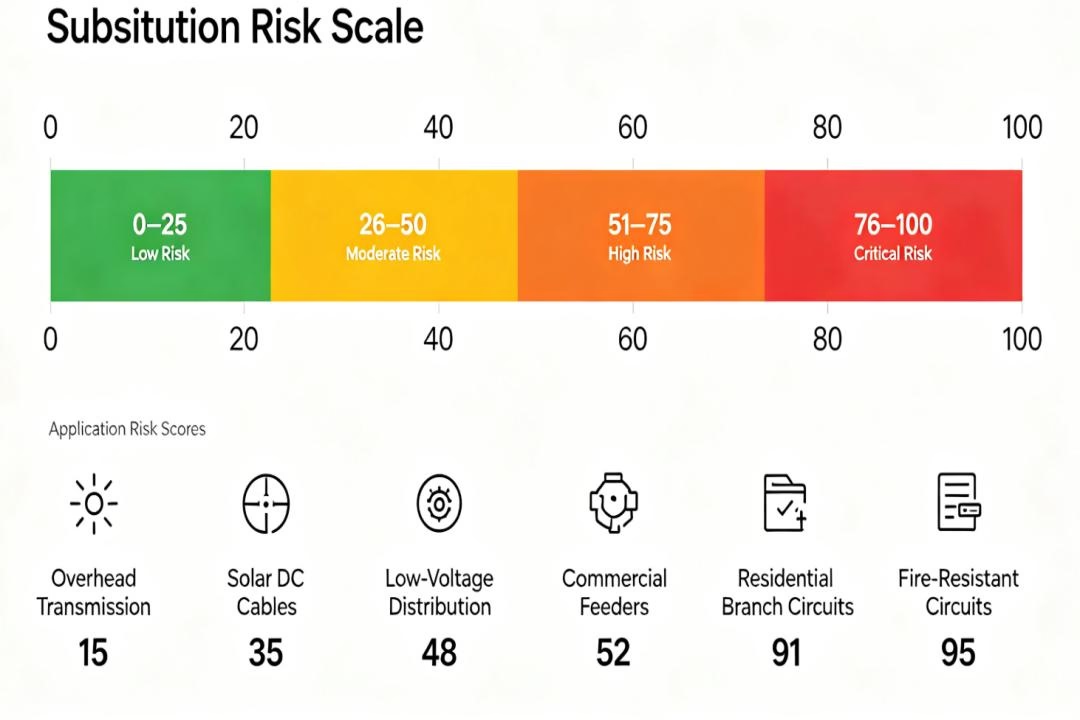
Substitution Risk Scale For Aluminum Replacing Copper Conductors.
Based on the technical, safety, and economic factors above, we have developed a comprehensive Substitution Risk Scale. This scale evaluates the risk of substituting aluminum for copper across different applications, considering:
Technical feasibility (Can aluminum physically do the job?)
Safety implications (Does substitution create fire or failure hazards?)
Long-term reliability (Will the installation perform over its intended lifespan?)
Installation complexity (Does substitution require specialized skills?)
Code compliance (Does substitution meet regulatory requirements?)
Risk Score Categories
| Score Range | Risk Level | Meaning |
|---|---|---|
| 0–25 | Low Risk | Aluminum is well-established, code-compliant, and widely used. Substitution is routine. |
| 26–50 | Moderate Risk | Aluminum can work with proper design and installation, but requires attention to detail. |
| 51–75 | High Risk | Significant technical challenges exist. Substitution should be carefully evaluated case-by-case. |
| 76–100 | Critical Risk | Substitution is strongly discouraged or prohibited. Safety, code, or performance issues are severe. |
Application-Specific Risk Scores
1. High-Voltage Overhead Transmission Lines — Risk Score: 15
Example: 110kV, 220kV, 500kV transmission lines
Aluminum has been the standard conductor for overhead transmission lines for over a century. Steel-reinforced aluminum conductors (ACSR) were first industrialized in 1909. Today, aluminum conductors account for over 90% of new overhead transmission lines.
Why the risk is low:
Over 100 years of proven reliability
Weight advantage is critical for long spans between towers
Air cooling allows larger conductors without overheating
Steel core provides mechanical strength
Industry standards and installation practices are mature
Verdict: Aluminum is the preferred material. No risk concern.
2. Utility-Scale Solar DC Collection Cables — Risk Score: 35
Example: Large solar farm combiner box to inverter connections
In utility-scale photovoltaic plants, where total cable length can reach hundreds of kilometers, aluminum is gaining significant traction. Aluminum alloy cables already cover approximately 60% of DC combiner and AC low-voltage cable applications in the solar sector.
Why the risk is moderate:
Cost savings are substantial (20–40% material cost reduction)
Weight reduction simplifies installation
However, termination quality is the primary technical risk
Module-to-module connections and control/communication wiring still require copper
Verdict: Aluminum is viable with proper termination practices. Risk is manageable.
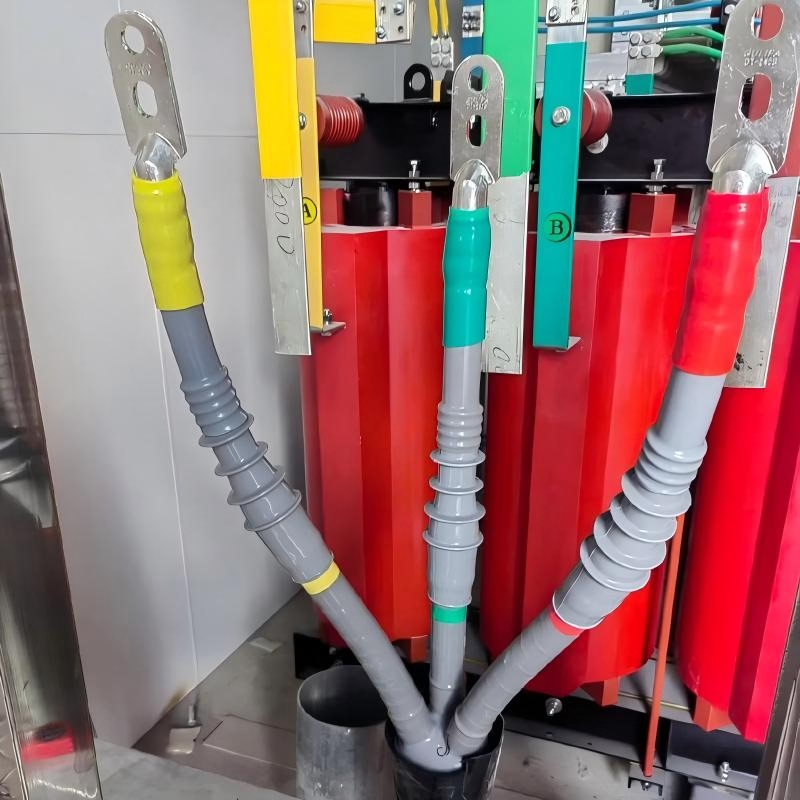
3. Medium-Voltage Distribution (10kV and Above) — Risk Score: 82
Example: 10kV, 20kV, 35kV underground distribution feeders
Medium-voltage networks rigidly require copper. The reasons are clear:
Why the risk is critical:
Long supply distances and concentrated loads
Underground or enclosed installation makes maintenance difficult
Creep and oxidation at joints are unacceptable failure modes
Aluminum’s conductivity shortcomings have significant impact on system losses
Code requirements in many jurisdictions mandate copper for medium voltage
Verdict: Substitution is strongly discouraged. Copper remains the standard.
4. Low-Voltage Distribution (1kV and Below) — Risk Score: 48
Example: Building feeders, subpanel connections, 480V/240V distribution
Low-voltage distribution is the core battleground for aluminum substitution. State Grid procurement data shows aluminum alloy cables already account for 45% of purchases in 2025, expected to exceed 50% during the 2026–2030 period.
Why the risk is moderate:
Short supply distances minimize voltage drop concerns
Loads are distributed, reducing single-point failure risks
Modern AA8030 and AA8060 rare-earth aluminum alloys improve joint stability
Cost advantages are compelling for large-scale projects
However:
Connection quality is paramount—80% of cable faults occur at joints
Improper installation can create fire hazards
Requires specialized connectors and anti-oxidant compounds
Verdict: Aluminum is viable with proper design and installation. Risk is elevated but manageable.
5. Residential Branch Circuit Wiring — Risk Score: 91
Example: 120V/240V household outlets, lighting circuits, 15A/20A branch circuits
Residential aluminum wiring has a troubled history. According to the U.S. Consumer Product Safety Commission (CPSC), homes wired with aluminum manufactured before 1972 are 55 times more likely to have connections reaching “fire hazard conditions” than homes wired with copper.
The CPSC has collected reports of over 165 aluminum wiring failures and numerous aluminum-related fires.
Why the risk is critical:
Aluminum’s thermal expansion loosens connections over time
Oxide formation increases resistance at termination points
The metal’s softness means terminal screws can damage the conductor during installation
Many jurisdictions restrict or prohibit aluminum in residential branch circuits
Insurance policies may be voided by the presence of aluminum wiring
Note: Properly installed aluminum feeders (large-gauge service entrance conductors) are considered reliable. The risk is primarily with branch circuit wiring.
Verdict: Aluminum is strongly discouraged for residential branch circuits. Copper is the safe standard.
6. Commercial Building Feeders — Risk Score: 52
Example: 100A–400A feeders to subpanels, lighting panels, HVAC equipment
Commercial feeders occupy a middle ground. The economics are attractive—for a standard 100-amp circuit, NEC Table 310.16 requires 3 AWG copper or 1 AWG aluminum. Aluminum saves significant material cost.
Why the risk is elevated:
Higher loads than residential branch circuits
Longer runs increase voltage drop concerns
Commercial buildings have higher stakes (occupant safety, business continuity)
Requires skilled electricians familiar with aluminum termination techniques
Regular thermal imaging inspections are recommended
Verdict: Aluminum is acceptable with qualified installation and ongoing maintenance. Risk is moderate to high.
7. Electric Vehicle Wiring Harnesses — Risk Score: 44
Example: EV battery-to-motor connections, high-voltage cabling
The automotive industry is embracing aluminum with remarkable speed. Ferrari, BMW, Tesla, and Chinese EV manufacturers like Avatr, XPeng, and Xiaomi have all adopted aluminum wiring harnesses. Ferrari reports weight reductions of 15–20% on its 296 hybrid.
Why the risk is moderate:
Weight reduction directly improves range
Cost savings are substantial—aluminum costs roughly one-quarter of copper
Automotive engineers can design for aluminum from the start
Controlled manufacturing environments ensure proper terminations
However:
Galvanic corrosion between aluminum and copper contacts is a concern
Vibration environments exacerbate connection loosening
Higher operating temperatures in EVs stress aluminum’s thermal properties
Verdict: Aluminum is gaining acceptance but requires careful engineering. Risk is moderate.
8. Fire-Resistant / Emergency Circuits — Risk Score: 95
Example: Fire pumps, emergency lighting, smoke evacuation systems, life safety circuits
This is where aluminum simply cannot compete. Fire-resistant cables must maintain circuit integrity during a fire—typically tested at 750–1,000°C.
Why the risk is critical:
Aluminum melts at 660°C, far below fire test temperatures
Copper melts at 1,080°C, providing a critical margin
Fire codes in most jurisdictions mandate copper for life safety circuits
The consequences of failure are catastrophic
Verdict: Aluminum is not acceptable for fire-resistant or life safety applications. Copper is mandatory.
9. Underground Direct Burial — Risk Score: 58
Example: Underground service entrances, submain feeders, campus distribution
Underground installation adds layers of complexity. Moisture ingress, soil conditions, and the inability to easily inspect or repair connections elevate risk.
Why the risk is elevated:
Galvanic corrosion risk between copper and aluminum is significant in wet environments
Aluminum alloy conductors typically require cross-sections 1.5 to 2 sizes larger than copper for the same load
Repairs are expensive and disruptive
Connection failures may go undetected until catastrophic failure occurs
Verdict: Aluminum is possible with proper waterproofing and corrosion protection, but risk is significant.
10. Control and Instrumentation Cabling — Risk Score: 88
Example: 24V DC control circuits, PLC wiring, sensor cables, communication lines
Control circuits demand signal integrity and reliability. The stakes are high—a failed control circuit can shut down an entire process.
Why the risk is critical:
Small conductor sizes amplify connection issues
Signal degradation from higher resistance is unacceptable
Control circuits often run through harsh industrial environments
Reliability is paramount; maintenance access may be limited
Verdict: Copper remains the standard. Aluminum substitution is strongly discouraged.
Risk Summary Table
| Application | Risk Score | Recommendation |
|---|---|---|
| High-voltage overhead transmission | 15 | Preferred material |
| Utility-scale solar DC cables | 35 | Viable with proper terminations |
| Medium-voltage distribution (10kV+) | 82 | Strongly discouraged |
| Low-voltage distribution (≤1kV) | 48 | Viable with qualified installation |
| Residential branch circuits | 91 | Strongly discouraged |
| Commercial building feeders | 52 | Acceptable with skilled installation |
| Electric vehicle wiring harnesses | 44 | Gaining acceptance, careful engineering required |
| Fire-resistant/emergency circuits | 95 | Not acceptable—copper mandatory |
| Underground direct burial | 58 | Possible with protection, significant risk |
| Control/instrumentation cabling | 88 | Strongly discouraged |
The Copper-Aluminum Price Ratio: The Tipping Point
Understanding the substitution risk requires understanding the economic trigger.
Industry analysts have long viewed a copper-to-aluminum price ratio of 3.5 as the “tipping point” for mass substitution. At this ratio, the cost savings from switching to aluminum begin to outweigh the technical challenges.
Today’s ratio of 4.2–4.4 represents an overwhelming economic incentive. As one analyst put it: “The economic incentive to switch has moved from advantageous to overwhelming”.
However, the risk scale demonstrates that economics alone cannot justify substitution. In applications like residential branch circuits, fire-resistant cables, and medium-voltage distribution, the technical and safety risks far outweigh any cost savings.
Installation Best Practices for Aluminum Cables
If you choose to use aluminum cables, follow these critical practices:
Use only CO/ALR-rated connectors specifically designed for aluminum
Apply anti-oxidant compound to all stripped conductor surfaces
Torque connections to manufacturer specifications—over-tightening can damage the conductor; under-tightening creates resistance
Use larger conduits to accommodate aluminum’s larger cross-sections
Consider thermal imaging inspections periodically to detect developing hot spots
Never mix copper and aluminum directly without proper bi-metallic connectors—galvanic corrosion will occur
Train installers on aluminum-specific techniques—aluminum is “less forgiving” than copper
The Verdict: A Nuanced Answer
The question “Should I substitute aluminum for copper?” has no single answer. The Substitution Risk Scale demonstrates that risk varies dramatically by application:
In overhead transmission: Aluminum is the standard, not a substitute.
In residential branch circuits: Aluminum is a fire hazard.
In fire-resistant systems: Aluminum is simply not an option.
In commercial feeders: Aluminum can work—if installed correctly.
As the copper-aluminum price ratio remains elevated, substitution pressure will continue to grow. According to J.P. Morgan, aluminum will displace approximately 2% of global copper demand in 2026, rising to 6% by 2030. But this substitution will be concentrated in applications where the risk is manageable—not across the board.
The smart approach is application-specific evaluation. Use the Substitution Risk Scale as a framework, but always consult the latest codes, standards, and qualified professionals for your specific project.
References
Consumer Product Safety Commission (CPSC) – Aluminum Wiring Safety Recommendations
National Electrical Code (NEC) Table 310.16 – Ampacities of Insulated Conductors
Nexans – Aluminum vs. Copper Conductors Technical Reference
J.P. Morgan – Global Copper Demand Substitution Forecast
U.S. CPSC Publication 516 – Repairing Aluminum Wiring
This analysis is for informational purposes only. Always consult the latest edition of the National Electrical Code and work with qualified professionals for electrical installations.