
 Minxing Cable
 Jinhuanyu Cable
 Jinlongyu Cable
 Guangdong Cable
 Zhujiang Wire & Cable




Introduction
Imagine for a moment the staggering amount of electrical current required to power a modern industrial facility. The massive motors driving conveyor belts. The arc welders fusing steel. The cranes lifting tons of material. The backup generators standing ready for emergencies.
Behind all of this, there is a single conductor that makes it possible: 4/0 copper cable.
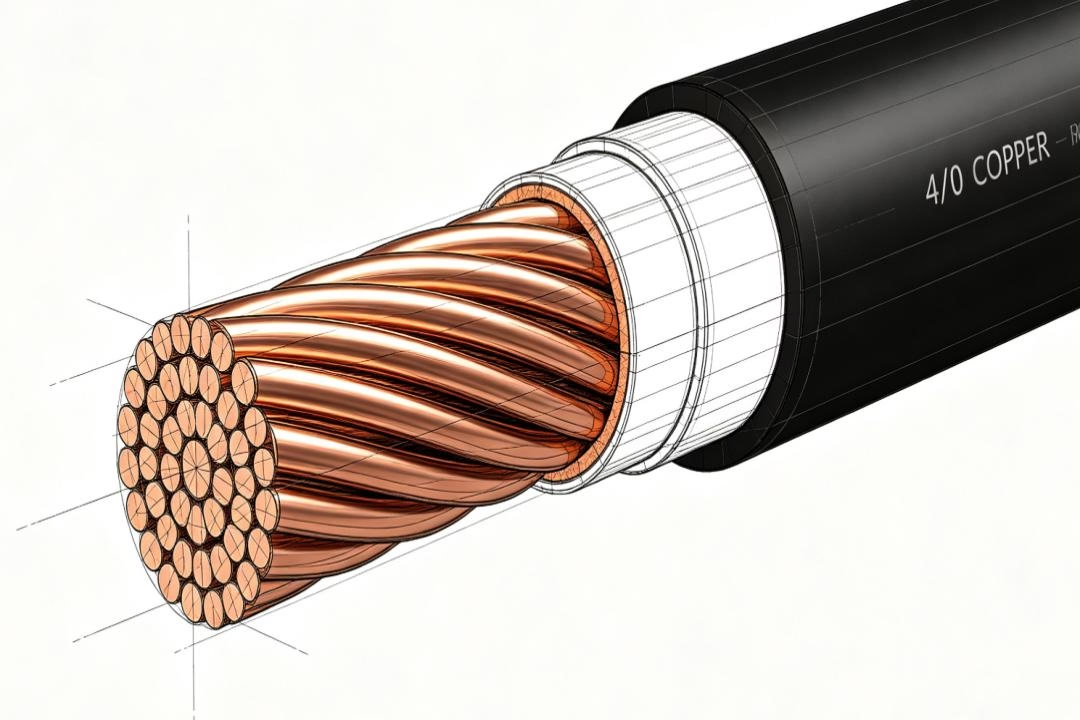
The American Wire Gauge (AWG) system can be counterintuitive—the smaller the number, the larger the wire. At 4/0 AWG (pronounced “four-aught”), we are talking about a conductor with a diameter of 11.68 mm (0.460 inches) and a cross-sectional area of 107.2 mm². This is not your everyday household wiring. This is the heavy artillery of the electrical world.
But what makes 4/0 copper cable so special? Why do engineers consistently choose it for the most demanding power distribution applications? And more importantly—is it the right choice for your project?
This comprehensive guide answers these questions and more, providing you with the technical knowledge needed to make informed decisions about 4/0 copper cable.
What Is 4/0 Copper Cable?
Before we dive into the technical details, let us establish a clear understanding of what 4/0 copper cable actually is.
The 4/0 designation refers to the conductor size under the American Wire Gauge (AWG) system. In this system, “0” (pronounced “aught”) represents a specific wire size, and “4/0” indicates four steps above 0 AWG. This places 4/0 AWG among the largest standard conductor sizes available—just below the transition to kcmil (thousand circular mils) sizes.
The physical specifications of 4/0 copper cable are impressive:
| Specification | Value |
|---|---|
| Conductor Diameter | 11.68 mm (0.460 in) |
| Cross-Sectional Area | 107.2 mm² |
| Area in Circular Mils | 211,600 cmil |
| DC Resistance at 20°C | 0.16 Ω/km |
| DC Resistance at 25°C | 0.0533 Ω/1000 ft |
| Approx. Weight (Bare) | 653 lb/1000 ft |
This is a conductor built for serious work. A 100-foot spool can weigh over 70 pounds (32 kg). Its weight and stiffness make installation a physical challenge that requires heavy-duty cutters and hydraulic crimpers.
The Ampacity of 4/0 Copper Cable: What It Can Really Handle
The most critical specification for any power cable is its ampacity—the maximum current it can carry continuously without exceeding its temperature rating. Ampacity depends on several factors: conductor material, insulation type, ambient temperature, and installation conditions.
Under the National Electrical Code (NEC) Table 310.16, the ampacity of 4/0 copper cable varies based on the insulation temperature rating:
| Insulation Temperature Rating | Ampacity |
|---|---|
| 60°C (140°F) | 195A |
| 75°C (167°F) | 230A |
| 90°C (194°F) | 260A |
These values assume an ambient temperature of 30°C (86°F) and no more than three current-carrying conductors in a raceway or cable.
The 260-amp figure in the 90°C column is what makes 4/0 copper cable truly remarkable. This is enough current to power:
A large commercial building’s main electrical service
Multiple heavy-duty industrial motors simultaneously
An electric vehicle fast-charging station
A substantial portion of a data center’s power infrastructure
However, a critical caveat applies. Under NEC 110.14(C), the ampacity is limited by the lowest temperature rating in the circuit, not just the cable rating. If a 90°C-rated 4/0 cable connects to a 75°C-rated terminal, the effective ampacity is limited to 230A—the 75°C column value.
4/0 Copper vs. 4/0 Aluminum: A Critical Comparison
One of the most common questions about 4/0 cable is whether copper or aluminum is the better choice. The answer depends on your priorities.
Ampacity Comparison
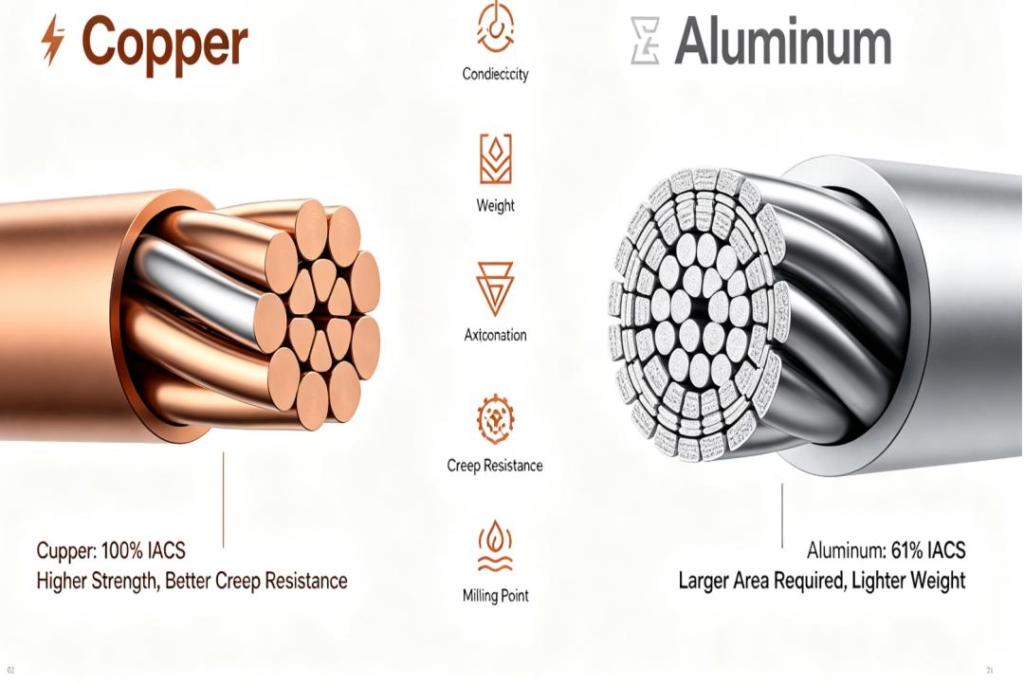
At 75°C insulation rating—the most common for practical applications—4/0 copper is rated at 230A, while 4/0 aluminum is rated at 180A. This means a 4/0 copper conductor can carry 28% more current than the same size aluminum conductor.
To achieve the same 230A capacity with aluminum, you would need to use 250 kcmil aluminum, which is physically larger and more expensive to install.
Physical Properties
| Property | 4/0 Copper | 4/0 Aluminum |
|---|---|---|
| Ampacity (75°C) | 230A | 180A |
| Conductivity | 100% IACS | ~61% IACS |
| Melting Point | 1,080°C | 660°C |
| Weight | Heavier | ~3× lighter |
| Corrosion Resistance | Excellent | Requires special precautions |
The Verdict
Copper is the superior conductor for 4/0 applications where:
Space is limited (copper needs less space for the same ampacity)
Long-term reliability is critical (copper connections stay tight)
Fire safety is paramount (copper’s melting point is 420°C higher)
Voltage drop must be minimized (copper’s lower resistance means less drop)
Aluminum may be preferred where:
Weight is the primary concern (overhead lines, long spans)
Initial cost is the overriding factor
Applications: Where 4/0 Copper Cable Is Used
4/0 copper cable finds use across an extraordinarily wide range of demanding applications:
1. Main Electrical Services
For residential and commercial buildings with high power demands, 4/0 copper cable is commonly used for the main service entrance. It is the standard choice for 200-amp residential services and many commercial installations.
2. Industrial Power Distribution
Manufacturing plants, processing facilities, and heavy industry rely on 4/0 copper cable for power distribution to large motors, welding equipment, and production machinery. Type W portable power cable in 4/0 AWG is used in extremely demanding applications including mining equipment, diesel electric locomotives, cranes, conveyors, and drills.
3. Submersible Pumps and Marine Applications
Southwire’s Type G cable—available in 4/0—is suitable for continuous submersion in water, making it ideal for submersible pumps and marine applications. The cable is also sunlight and oil resistant.
4. Renewable Energy Systems
4/0 copper cable is widely used in solar installations, battery banks, and inverter connections for renewable energy systems. Its high ampacity makes it suitable for the large currents involved in energy storage and conversion.
5. Data Centers
The explosive growth of cloud computing and AI has driven unprecedented demand for data center capacity. 4/0 copper cable is used for power distribution to server racks, cooling systems, and backup power infrastructure.
6. Welding and Portable Equipment
4/0 AWG welding cable is designed for use as arc welding leads from the secondary side of power sources. It is flame retardant, oil resistant, resilient, and survives rough handling.
7. Medium-Voltage Distribution
4/0 copper cable is also available in medium-voltage configurations (up to 15kV and higher) for primary underground distribution, feeder applications in substations, and industrial facilities.
Installation Considerations
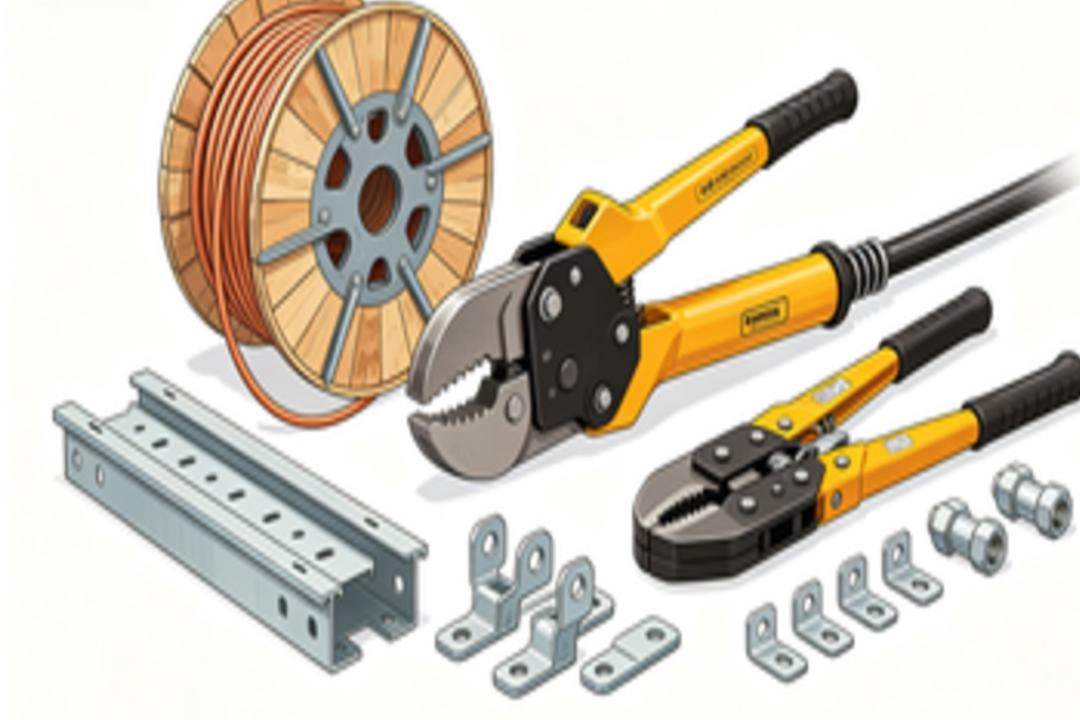
Technical Illustration Showing Essential Tools And Hardware For Installing 4/0 Awg Copper Cable: Cable Reel, Heavy-Duty Cable Cutter, Hydraulic Crimping Tool, Cable Tray, Terminal Lugs And Fasteners. Specialized Equipment Is Required To Handle Large-Diameter Heavy Power Conductors.
Installing 4/0 copper cable is not a job for the faint of heart. Here are the key considerations:
Weight and Handling
A 100-foot spool of 4/0 copper cable can weigh over 70 pounds (32 kg). This weight, combined with its stiffness, makes installation a physical challenge. Proper lifting equipment and multiple installers are often required.
Tools Required
Installing 4/0 cable requires specialized tools:
Heavy-duty cable cutters capable of cleanly cutting large conductors
Hydraulic crimpers for terminal lugs
Strong supports for long runs in cable trays or raceways
Bending Radius
4/0 copper cable has a significant minimum bending radius. Sharp bends can damage the conductor or insulation. Always consult the manufacturer’s specifications for the minimum bend radius.
Termination
Terminating 4/0 copper cable requires:
Properly sized lugs and connectors rated for the conductor size
Correct torque specifications to ensure secure connections
Anti-oxidant compound (particularly important when connecting to aluminum terminals)
Voltage Drop
For long runs, voltage drop can be significant. A 4/0 copper conductor at 75°C has a resistance of approximately 0.0533 Ω/1000 ft. For a 200A load over 100 feet, the voltage drop would be:
Voltage Drop = 2 × 0.0533 Ω/1000 ft × 100 ft × 200A / 1000 = 2.13V
On a 240V circuit, this represents less than 1% drop—well within acceptable limits.
Frequently Asked Questions
Q: What does 4/0 mean?
A: 4/0 (pronounced “four-aught”) is a wire size designation in the American Wire Gauge system. It indicates a conductor with a diameter of 11.68 mm (0.460 inches) and a cross-sectional area of 107.2 mm².
Q: What is the ampacity of 4/0 copper cable?
A: According to NEC Table 310.16, 4/0 copper cable has ampacities of 195A at 60°C, 230A at 75°C, and 260A at 90°C. The actual ampacity is limited by the lowest temperature rating in the circuit.
Q: What size breaker do I need for 4/0 copper cable?
A: For 4/0 copper at 75°C (230A), a 200A breaker is commonly used for residential services. The breaker size depends on the specific application and load requirements.
Q: Can 4/0 copper cable be used for 200-amp service?
A: Yes. 4/0 copper at 75°C is rated for 230A, making it suitable for 200-amp services with adequate safety margin.
Q: How much does 4/0 copper cable weigh?
A: Bare 4/0 copper cable weighs approximately 653 lb per 1000 feet. A 100-foot spool weighs over 70 pounds (32 kg). Insulated and jacketed versions weigh significantly more.
Q: What is the difference between 4/0 copper and 4/0 aluminum?
A: At 75°C, 4/0 copper is rated for 230A while 4/0 aluminum is rated for 180A. Copper also has higher conductivity, a higher melting point, and better long-term connection reliability.
Q: Where can I find official NEC ampacity tables?
A: The official tables are published in NFPA 70, the National Electrical Code. They are also available through various online references and the NFPA website (www.nfpa.org). Google search results provide numerous resources, including tables from engineering reference sites.
Conclusion
4/0 copper cable is a powerhouse conductor that plays an essential role in modern electrical infrastructure. Its ability to carry up to 260 amps—combined with copper’s superior conductivity, durability, and fire resistance—makes it the conductor of choice for the most demanding applications.
From residential 200-amp services to industrial power distribution, from submersible pumps to data centers, 4/0 copper cable delivers the performance and reliability that critical systems demand.
Understanding the ampacity ratings, the difference between copper and aluminum, and the installation requirements is essential for making informed decisions. Compliance with standards like the National Electrical Code (NEC) ensures safety, performance, and code compliance.
When you choose 4/0 copper cable, you are not just buying wire—you are investing in a power distribution system that will perform reliably for decades to come.
References
National Electrical Code (NFPA 70), Table 310.16 – Ampacities of Insulated Conductors
NEC 110.14(C) – Temperature Limitations of Terminations
Southwire – Type G Cable Specifications
Various engineering reference sites including electriciancalc.com, elecalculator.com, and kristechwire.com
This guide is for informational purposes only. Always consult the latest edition of the National Electrical Code and work with qualified professionals for electrical installations.