 Minxing Cable
 Jinhuanyu Cable
 Jinlongyu Cable
 Guangdong Cable
 Zhujiang Wire & Cable




Introduction
Walk into any office building, any data centre, any home in almost any country on Earth, and you will find it. Not fibre optics. Not 5G. Copper cable.
Despite all the headlines about fibre-to-the-home and the relentless march of wireless technology, the reality is this: over 1.53 billion people around the world were connected to fixed broadband as of mid-2025. And a significant portion of those connections—hundreds of millions—still run, at least in part, over copper cable.
The global copper network cables market is not shrinking. It is growing, with a projected compound annual growth rate of 3.4% from 2025 to 2031. The copper telecom cables market alone was valued at approximately $6.5 billion in 2025.
How is this possible? Why hasn’t fibre optics simply replaced copper everywhere?
The answer is more nuanced than you might think. Copper cable internet is not a single technology. It is a family of technologies—from the humble DSL line to the sophisticated DOCSIS 4.0 cable network—that continue to evolve, adapt, and serve billions of users.
This article explores the current state of copper cable internet, its limitations, its surprising staying power, and what the future holds.
What Exactly Is Copper Cable Internet?
Before we dive into the numbers and the debates, let us be clear about what we are talking about.
Copper cable internet refers to any internet connection that uses copper-based cabling as the transmission medium. This includes several distinct technologies:
Digital Subscriber Line (DSL)
DSL uses traditional copper telephone lines—the same twisted-pair copper wires that Alexander Graham Bell patented in 1881. ADSL (Asymmetric DSL) brought speeds of 6 Mbps to millions of households when it was introduced in 1999. Later iterations pushed these limits further: ADSL2+ (up to 20-24 Mbps), VDSL2 (up to 80 Mbps), G.fast (up to 330 Mbps), and MGfast (up to 10 Gbps). DSL remains the slowest common fixed broadband option, with real-world capability typically topping out at tens of Mbps on long copper loops. According to European tariff data from Q2 2025, the average copper-based residential broadband speed was just 23 Mbps.
Cable Broadband (DOCSIS)
Cable broadband uses hybrid fibre-coax (HFC) networks—fibre to the neighbourhood node, and traditional copper coaxial cable the rest of the way. This is the technology used by most cable TV providers. In 2025, common cable download tiers range from 200 Mbps to 1.2 Gbps. The average cable tariff in Europe in Q2 2025 offered 653 Mbps.
Fibre-to-the-Cabinet (FTTC)
FTTC is a hybrid approach: fibre optic cable runs to a street cabinet, and the final connection to the home uses existing copper telephone lines. This is the dominant form of “fibre broadband” in many countries, even though the last mile is still copper.
The distinction matters. When you hear “fibre broadband” in many markets, you are often getting copper to the premises—not pure fibre.
The Two Faces of Copper Internet: DSL vs. Cable
If you are on copper internet today, you are almost certainly on one of two networks: the telephone network (DSL) or the cable TV network (DOCSIS). They are not the same.
DSL: The Telephone Company’s Network
DSL uses the copper twisted pairs that have been strung to homes for over a century. It is widely available—almost every home with a landline has access to some form of DSL. But the performance is distance-dependent. The farther you are from the telephone exchange, the slower your connection. ADSL2+ may offer 20 Mbps within 1.5 kilometres of the exchange but drop to just 1-2 Mbps at 5 kilometres or more.
DSL is declining rapidly. In Q2 2025, legacy copper subscriptions declined by 12.1% year-over-year. Spain became one of the first major economies to shut down its copper network completely in May 2025. In the UK, BT has announced plans to shut down its PSTN and ISDN networks by December 2027. In the US, only about eight percent of homes still use copper for broadband access.
Cable Broadband: The Cable TV Company’s Network
Cable broadband uses coaxial cable—the same thick copper cable that delivers cable television. It is faster than DSL because coaxial cable has more bandwidth capacity than twisted-pair telephone wire. It is also less distance-dependent because the fibre node is typically much closer to the home.
Cable broadband is evolving rapidly. DOCSIS 4.0—the latest standard for cable internet—enables multi-gigabit downstream speeds and substantially higher upstream capacity over existing HFC networks. In September 2025, Vantiva and CommScope achieved download speeds of 13 Gbps with a single DOCSIS 4.0 modem. CableLabs is already working on an optional annex to DOCSIS 4.0 that would support up to 25 Gbps.
Cable broadband is not going away. While fibre is winning the long-term battle, cable operators are extracting astonishing performance from their existing copper infrastructure.
The Physical Limits: Why Copper Has a Distance Problem
Copper cable internet has one fundamental limitation that no amount of technological innovation can fully overcome: physics.
Signal Attenuation
Electrical signals degrade over distance. The longer the copper wire, the weaker the signal becomes. This is why DSL speeds drop dramatically as you move away from the telephone exchange. Even advanced technologies like G.fast, which can deliver up to 1 Gbps, are limited to cable lengths of about 250 metres.
Interference
Copper cables are susceptible to electromagnetic interference. The higher frequency spectrums required for fast speeds are more vulnerable to interference and degradation. This can result in slower connections and unstable service.
The Fibre Advantage
Fibre optic cables transmit data using light signals. They are immune to electromagnetic interference and can carry signals over much longer distances without degradation. A comparative study of Cat6 copper Ethernet versus fibre found that fibre exhibits consistently lower latency and jitter and near-zero loss across all conditions. At longer copper runs (90–100 metres), the gap widens: copper shows higher jitter, higher loss, and increased error-related counters, while fibre remains stable.
The copper distance limit is the primary reason why fibre is the long-term winner for high-speed internet. But for the last mile—the connection from the street cabinet to your home—copper still works. And for many users, it works well enough.
The Economics: Why Copper Refuses to Die
If fibre is so much better, why hasn’t it replaced copper everywhere? The answer is economics.
The Cost of Replacement
Replacing copper with fibre is expensive. Really expensive. It involves digging up streets, running new cables to millions of homes, and installing new equipment at exchanges and cabinets. In many areas, the cost of fibre deployment simply cannot be justified by the number of subscribers.
This is why hybrid solutions like FTTC (fibre to the cabinet, copper to the home) and G.fast are so popular. They deliver a significant speed boost using the existing copper infrastructure, at a fraction of the cost of full fibre-to-the-home.
The Initial Cost Advantage
Copper cabling typically has a lower initial installation cost than fibre. According to industry data, copper can be 30% to 50% less expensive than fibre in terms of upfront investment. For many businesses and network operators, this cost advantage is decisive—particularly for short-distance connections, non-critical network links, or temporary deployments.
The Maintenance Cost Trade-off
However, the long-term picture is different. Maintaining copper networks is expensive and energy-intensive. Fibre-based networks are 70% to 90% more reliable, consume 40% to 60% less energy, and deliver nearly 60% operational savings every year. Copper networks require complex infrastructure with amplifiers, batteries, and air systems that often fail and need frequent servicing. Meanwhile, the tools and components needed to fix copper systems are becoming rare and expensive because they are no longer widely manufactured.
The Residential Tariff Reality
In Europe, the average monthly cost for copper-based residential broadband in Q2 2025 was $50 PPP**, delivering an average speed of just **23 Mbps**. Fibre, by contrast, cost **$71 PPP but delivered an average speed of 815 Mbps. Fibre provides 35 times the speed for less than 1.5 times the cost.
The economics are clear: copper is cheap upfront but expensive over time. Fibre is expensive upfront but cheap over time. This is why the industry is steadily transitioning to fibre—but the transition takes decades, not years.
The Innovation Continues: Copper Is Not Standing Still
One of the most remarkable aspects of copper cable internet is how it has continued to improve. The cable categories tell the story:
| Technology | Max Speed | Distance Limit |
|---|---|---|
| ADSL (1999) | 6-8 Mbps | Several km |
| ADSL2+ | 20-24 Mbps | Several km |
| VDSL2 | 80 Mbps | ~1 km |
| G.fast | Up to 1 Gbps | ~250 m |
| MGfast | Up to 10 Gbps | ~100 m |
G.fast chipsets are revolutionizing broadband connectivity by enabling ultra-fast internet speeds over existing copper telephone lines, helping telecom companies deliver gigabit-level speeds without the costly need for fibre optic installations to every home. The G.fast chipset market is expected to grow from $3.3 billion in 2024 to $4.14 billion in 2025, a compound annual growth rate of 25.6%.
DOCSIS 4.0: Cable’s Answer to Fibre
On the cable broadband side, DOCSIS 4.0 is delivering fibre-like performance over existing coaxial cable networks. The standard enables multi-gigabit speeds with low latency and improved reliability. In September 2025, real-world testing achieved 13 Gbps download speeds. CableLabs is already working on an extension that would push speeds to 25 Gbps.
Copper is not obsolete. It is evolving.
Copper in the Data Centre: The Short-Range Champion
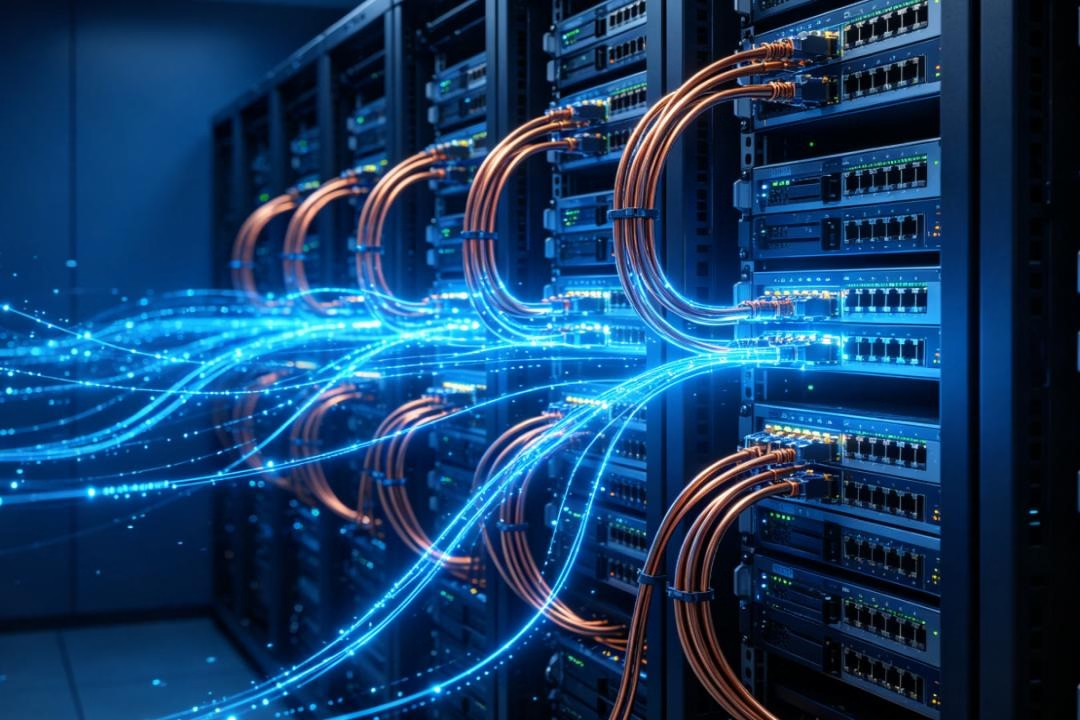
Photorealistic Data Centre Scene Showing Copper Ethernet Patch Cables Connecting Network Switches. Copper Cabling Remains A Cost-Effective, High-Performance Solution For Short-Range Server And Switch Interconnections Inside Data Centres, Supporting Cat6A / Cat7 / Cat8 High-Speed Transmission.
While fibre dominates long-distance connections, copper cables are still prevalent in data centres for short-range connections. The adoption of copper for short-range networking—connecting servers, switches, and storage devices—is increasing due to the cheaper and high-performance characteristics of copper.
Cat.7 standard cables achieve 10 Gbit/s, and Cat.8 cables reach 40 Gbit/s. For connections under 100 metres, copper delivers comparable performance to fibre at a significantly lower cost.
As one industry analysis notes, “not all network connections need to reach speeds of 100 billion bits per second. For medium and short distances, 10 Gbps or lower speeds, copper cables can reliably provide the required performance”.
The Future: What Happens to Copper Cable Internet?
The future of copper cable internet is one of gradual decline, not sudden death.
The Switch-Offs Are Coming
In May 2025, Spain became one of the first major economies to shut down its copper network completely. Practically 94% of ADSL lines had already been migrated to fibre. In the UK, the copper switch-off is scheduled for December 2027. In the US, the FCC took action in early 2025 to accelerate the transition from copper networks to modern, high-speed communications infrastructure.
But Copper Will Persist
Despite these switch-offs, copper will not disappear overnight. As one rural broadband user noted in official comments, in some areas “a copper broadband connection (VDSL) remains the only viable service due to geographic and technical limitations”. Removing copper service would leave these users without a reliable means to access the internet.
The global copper network cables market is still expected to grow at a CAGR of 3.4% through 2031. The copper telecom cables market is projected to grow at 2-3% CAGR through 2030. This growth is driven by niche applications, cost advantages, and the continued expansion of IoT and smart city technologies, where copper serves as a low-cost method of data transmission for devices and sensors.
The Hybrid Future
The future is hybrid. Copper and fibre will coexist for decades. Fibre will carry the long-haul traffic. Copper will handle the last mile in areas where fibre deployment is not economically viable. And in data centres, copper will continue to dominate short-range connections.
Conclusion
Copper cable internet is not a relic of the past. It is a living, evolving technology that still connects hundreds of millions of people to the internet. Yes, fibre is faster. Yes, fibre is more reliable. Yes, fibre is the future. But the future is not here yet—and for many people, it will not arrive for years.
Copper’s story is one of remarkable resilience. From Alexander Graham Bell’s twisted pair to today’s DOCSIS 4.0 and G.fast technologies, copper has adapted to every new demand placed upon it. It has gone from carrying voices to carrying data, from 56 kbps modems to multi-gigabit connections.
The copper cable internet market is worth billions. It employs thousands. And it still serves the vast majority of the world’s internet users in one form or another.
Copper cable internet is not dead. It is just getting started on its next chapter.
References
ITIF – Comments to the FCC Regarding Reducing Barriers and Accelerating Network Modernization (November 2025)
Point Topic – Global Broadband Subscribers in Q2 2025
Point Topic – European Broadband Operators and Tariffs Benchmark Report, Q2 2025
iFax – Copper Broadband Explained
Research and Markets – Copper Network Cables Market Report 2025-2031
Reviews.com – From Fiber to 5G: How Internet Connection Types Compare
Telefónica – The final farewell to ADSL and copper
CableLabs – DOCSIS 4.0 specifications
Various industry sources including Corning, Cablefax, and SDxCentral
This guide is for informational purposes only. Broadband availability, speeds, and pricing vary significantly by region and provider. Always check with local providers for specific offerings.