 Minxing Cable
 Jinhuanyu Cable
 Jinlongyu Cable
 Guangdong Cable
 Zhujiang Wire & Cable




Introduction
Every time you stream a movie, join a video call, or send a file to a colleague, you are relying on a technology that was invented in 1881.
That technology is twisted pair copper cabling. Alexander Graham Bell, the man who gave us the telephone, also gave us the cabling that still powers the vast majority of the world’s networks today.
It is easy to assume that fibre optics has taken over. It has not. While fibre dominates long-distance backbone connections and high-speed internet to the home, inside buildings—in offices, schools, hospitals, data centres, and factories—twisted pair copper cabling remains the undisputed king.
Why? Because it is cheaper, easier to install, more flexible, and—thanks to continuous innovation—capable of speeds that would have seemed impossible just a decade ago.
This guide explores seven compelling reasons why twisted pair copper cabling still rules every network you rely on, and why it will continue to do so for years to come.
What Exactly Is Twisted Pair Copper Cabling?
Before we dive into the reasons, let us get the basics straight.
A twisted pair cable consists of two separate insulated copper wires that are twisted together and run parallel to one another. This twisting is not for aesthetics; it is a critical engineering feature designed to reduce electromagnetic interference (EMI) and crosstalk from adjacent pairs.
When a wire conducts electricity, it naturally creates an electromagnetic field around it. This field can interfere with neighbouring wires, degrading signal quality. By twisting the wires together, the magnetic fields created by the electrical signals cancel each other out, ensuring a cleaner, more reliable signal.
The Two Main Types
Twisted pair cabling comes in two primary varieties:
Unshielded Twisted Pair (UTP) : The most common type of networking cable. It relies solely on the cancellation effect of the twisted pairs to handle interference. It is flexible, cost-effective, and ideal for standard office environments.
Shielded Twisted Pair (STP) : These cables feature an additional layer of foil or braided shielding to protect against heavy EMI. You should use shielded cables in environments with high electrical noise, such as near power cables or in industrial settings.
Reason 1: Alexander Graham Bell’s Brilliant Invention Still Works
Let us start with the most fundamental reason: the physics still work.
Bell’s twisted-pair design, invented in 1881, solves a problem that every electrical conductor faces: interference. When two wires run parallel to each other, they act like an antenna, picking up stray electromagnetic signals from power cables, motors, fluorescent lights, and other electrical equipment.
By twisting the wires, Bell created a system where the interference picked up by one half of the twist is cancelled out by the other half. The result is a cable that can carry clean signals through electrically noisy environments.
This is not a historical curiosity. It is the same principle that allows your office network to function reliably despite being surrounded by computers, monitors, printers, and power cables.
The twist is not a relic—it is a solution that has stood the test of time for over 140 years.
Reason 2: It Is Remarkably Cost-Effective
If fibre optics were cheaper, twisted pair would have disappeared years ago.
It has not. And the reason is simple: twisted pair copper cabling is significantly more affordable than fibre optics for shorter-distance deployments.
UTP cables are cheaper to manufacture, cheaper to transport, and cheaper to install. The connectors (RJ45) are standardised and inexpensive. The tools required for termination are simple and widely available.
This cost advantage is not marginal—it is substantial. For a typical office building, the difference in material and installation costs between copper and fibre can run into tens of thousands of dollars.
When cost matters—and it always does—twisted pair copper cabling is the clear winner.
Reason 3: Installation Is Fast and Flexible
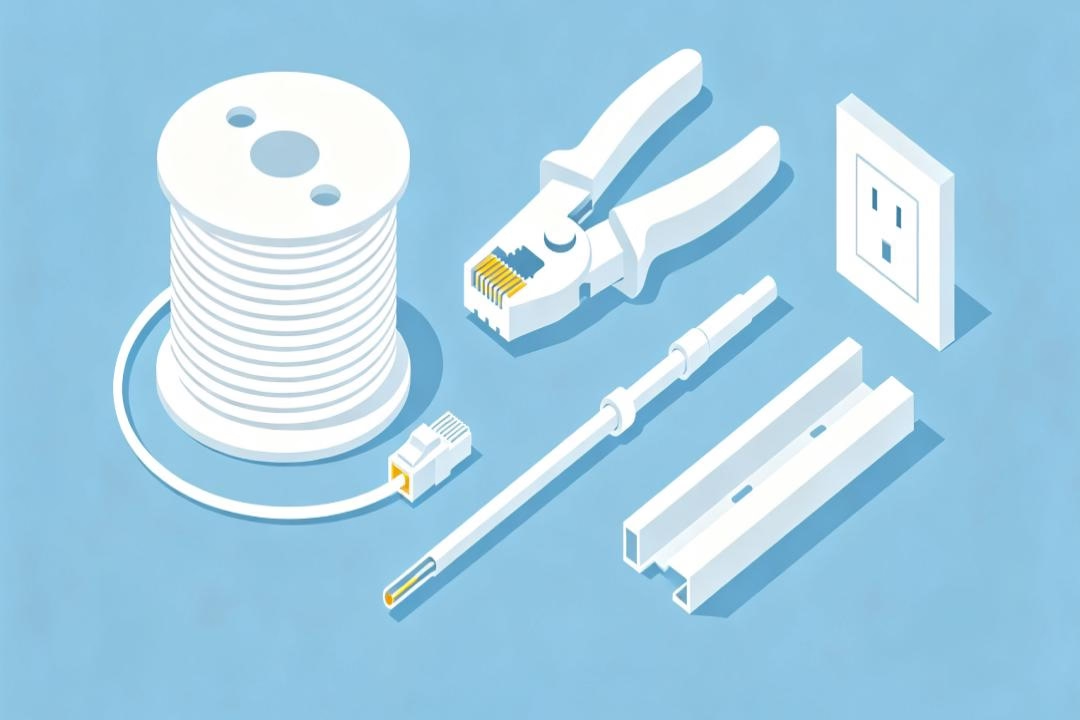
Isometric Illustration Showing Core Hardware For Twisted Pair Network Installation: Cable Reel, Rj45 Crimping Tool, Terminated Ethernet Plug, Cable Trunking And Wall Outlet. Twisted Pair Cabling Uses Simple, Widely Available Tools For Fast Field Termination.
Anyone who has installed fibre optic cabling knows the challenges: delicate fibres that can break if bent too sharply, expensive fusion splicing equipment, and the need for specialised training.
Twisted pair copper cabling is the opposite.
It is flexible and easy to install. It can be bent around corners without breaking. It can be pulled through conduits with standard tools. It can be terminated with a simple crimping tool that costs less than a good dinner.
Pre-made cables are easily available, and they are cheaper than coaxial cables, which they have largely replaced. For small networks with few devices or large networks with various technology, twisted pair cables are ideal.
Ease of installation means lower labour costs, faster project completion, and fewer headaches for everyone involved.
Reason 4: It Supports Power over Ethernet (PoE)—One Cable, Two Jobs
This is where twisted pair copper cabling truly shines.
Power over Ethernet (PoE) allows electrical power to be transmitted alongside data over the same Ethernet cable. This eliminates the need for separate power cables and outlets.
One cable. Two jobs. Data and power.
This capability has revolutionised how devices are deployed:
IP security cameras can be placed anywhere there is a network drop
Wireless access points require only a network cable, not an electrical outlet
VoIP phones eliminate the need for separate power supplies
IoT sensors can be deployed in locations where running power would be impractical
Cisco pioneered 60W PoE by leveraging all four twisted pairs, leading to the IEEE 802.3bt standard. Today, PoE can deliver up to 90W or more over standard twisted pair cabling.
Fibre optics cannot do this. Fibre transmits light, not electricity. If you need to power a device, you still need a separate power cable. Twisted pair copper does both—and that is a game-changer.
Reason 5: Performance Keeps Getting Better
One of the most remarkable aspects of twisted pair copper cabling is how it has kept pace with increasing bandwidth demands.
The cable categories tell the story:
Cat5e – Supports 1 Gbps at 100 MHz
Cat6 – Supports 1 Gbps* at 250 MHz, the modern standard for business LANs
Cat6a – Supports 10 Gbps at 500 MHz, ideal for data centres
Cat7/Cat7a – Supports 10 Gbps+ at 1000 MHz
*Cat6 can support 10 Gbps over shorter distances (up to 55 metres). Cat6a extends this to the full 100-metre channel.
The TIA/EIA-568 standard defines these categories, each supporting a different amount of bandwidth. Category 5e contains four twisted pairs and supports 1 gigabit per second (Gbps) for 100 metres. Category 6a extends electrical specifications from 250 MHz to 500 MHz.
The copper in your walls today can carry data at speeds that were unthinkable when it was installed. That is not obsolescence—that is future-proofing.
Reason 6: Solid Copper Conductors Deliver Superior Performance
Not all copper cabling is created equal. The internal structure of the copper determines where the cable should be used.
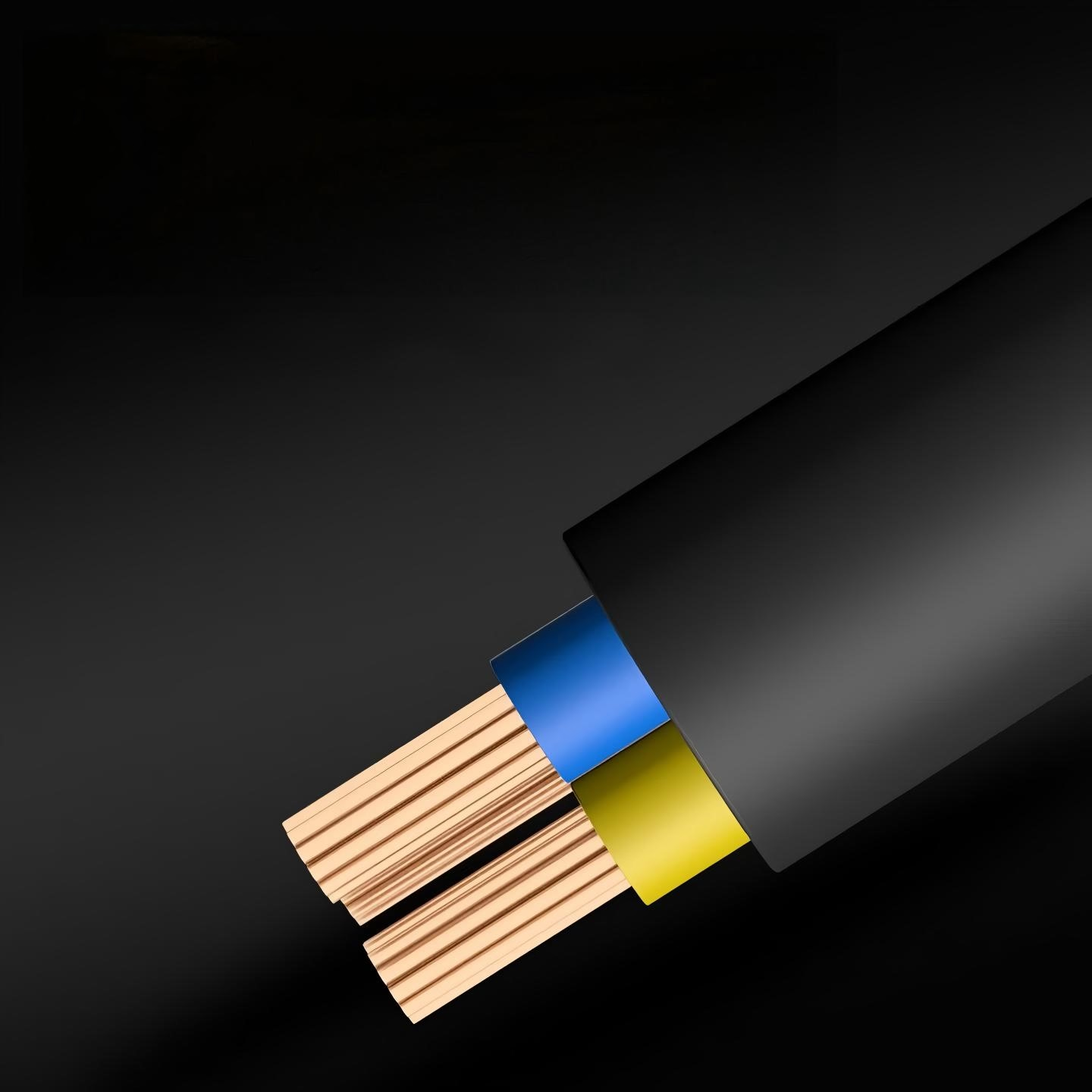
Solid core cable features one solid copper wire per conductor. It is designed for permanent installations, such as running through walls or under floors. It offers better signal strength over long distances but is less flexible.
Stranded cable is made up of multiple smaller copper wires twisted together. It is more flexible, making it more suitable for shorter distances, such as patch cords.
In general, solid wire cables are better electrical conductors than stranded wire cables, providing superior, stable electrical characteristics over a wider range of frequencies. This allows solid conductor cables to support longer transmission runs and higher data rates.
For permanent installations in both horizontal and backbone cabling subsystems, solid conductor cables are specified.
Choosing the right type of copper conductor matters for performance and reliability.
Reason 7: It Is Everywhere—and That Is Not Changing
The final reason is the simplest: twisted pair copper cabling is already everywhere.
It is in the walls of your home. It is in the ceiling of your office. It is in the data centres that power the internet. It is in factories, hospitals, schools, and airports.
The installed base is enormous. Replacing it with fibre would be prohibitively expensive and practically impossible without tearing buildings apart.
Moreover, the infrastructure that supports twisted pair—the tools, the training, the standards, the decades of expertise—is deeply embedded in the industry.
Twisted pair copper cabling is not going anywhere. It is the backbone of almost every local area network (LAN).
Common Misconceptions About Twisted Pair Cabling
“Fibre Is Always Better”
Fibre is better for long distances and very high speeds. But for the 100-metre reach that covers most in-building connections, twisted pair copper delivers comparable performance at a fraction of the cost.
“Copper Is Obsolete”
Copper is not obsolete—it is evolving. Category 6a and Category 7 cables demonstrate that copper can keep up with increasing bandwidth demands.
“Shielded Is Always Better”
Shielding adds cost and reduces flexibility. In most office environments, UTP is perfectly adequate. STP is only necessary in environments with high electromagnetic interference.
“Twisted Pair Can’t Handle High Power”
Modern PoE standards deliver up to 90W or more over twisted pair cabling—enough to power high-performance wireless access points, PTZ cameras, and even laptops.
How to Choose the Right Twisted Pair Cable
1. Consider the Application
Permanent in-wall installation: Solid core UTP or STP
Patch cords and flexible connections: Stranded cable
High-EMI environments: STP
Standard office environments: UTP
2. Choose the Right Category
Cat5e: Budget-friendly home networking
Cat6: The modern standard for business LANs
Cat6a: High-speed data centres and future-proofing
Cat7/Cat7a: Specialist industrial or AV applications
3. Verify Compliance
Ensure the cable meets TIA/EIA standards and is certified by reputable manufacturers.
4. Don’t Overlook the Connectors
RJ45 connectors must match the cable category and conductor type (solid vs. stranded). Using the wrong connector can compromise performance.
Frequently Asked Questions
Q: What is the maximum length for twisted pair copper cabling?
A: The standard maximum channel length is 100 metres (328 feet) for most Ethernet applications.
Q: What is the difference between UTP and STP?
A: UTP relies solely on the twisting of the pairs to cancel interference. STP adds an additional layer of foil or braided shielding for protection against heavy EMI.
Q: Can twisted pair cabling support 10 Gbps?
A: Yes. Cat6a supports 10 Gbps over the full 100-metre channel. Cat6 can support 10 Gbps but only up to 55 metres.
Q: What is the difference between solid and stranded copper conductors?
A: Solid conductors use one solid copper wire per conductor and are used for permanent installations. Stranded conductors use multiple smaller wires twisted together and are used for patch cords and flexible connections.
Q: Is twisted pair cabling still relevant in the age of fibre optics?
A: Yes. Twisted pair remains the backbone of almost every local area network (LAN) due to its cost-effectiveness, ease of installation, and continuous performance improvements.
Q: Where can I find official standards for twisted pair cabling?
A: The official standards are published by TIA/EIA (ANSI/TIA-568). They are also available through various online references and the TIA website (www.tiaonline.org). Google search results provide numerous resources, including guides from Comms-Express, TechTarget, and Fluke Networks.
Conclusion
Twisted pair copper cabling has been the backbone of communication networks for over 140 years. From Alexander Graham Bell’s original invention to today’s 10-gigabit Cat6a cables, it has consistently adapted to meet the demands of new technologies.
The seven reasons outlined in this guide explain why it still rules every network you rely on:
The physics of the twist still works
It is remarkably cost-effective
Installation is fast and flexible
It supports Power over Ethernet—one cable, two jobs
Performance keeps getting better
Solid copper conductors deliver superior performance
It is everywhere, and that is not changing
Twisted pair copper cabling is not a legacy technology waiting to be replaced. It is a living, evolving technology that continues to power the world’s networks.
When you choose twisted pair copper cabling, you are choosing a proven technology with a 140-year track record of reliability, performance, and value.
References
TechTarget – What is an Unshielded Twisted Pair (UTP)?
Comms-Express – Twisted Pair Cables: The Ultimate Guide to Copper Networking
CableWholesale – The Pros and Cons of Twisted Pair Cables
RS Online – Twisted Pair & Multicore Data Cable
Fluke Networks – Stranded vs. Solid Wire Cable
TE Connectivity – Twisted Pair Cable Performance
Various industry resources including Cisco, TIA/EIA, and engineering reference sites
This guide is for informational purposes only. Always consult the latest standards and work with qualified professionals for network installations.