 Minxing Cable
 Jinhuanyu Cable
 Jinlongyu Cable
 Guangdong Cable
 Zhujiang Wire & Cable




Introduction
When it comes to building a reliable network, the cable you choose matters just as much as the router or switch you connect. Yet, many installers and homeowners overlook one of the most critical specifications: whether the cable uses solid copper conductors or an inferior alternative.
Solid copper Ethernet cable represents the gold standard for structured cabling. It delivers superior signal integrity, complies with all major safety standards, and provides the long-term reliability that permanent infrastructure demands. But with cheap copper-clad aluminum (CCA) cables flooding the market—often at prices that seem too good to be true—understanding the difference has never been more important.
This comprehensive guide covers everything you need to know about solid copper Ethernet cable: what it is, why it outperforms alternatives, how to identify quality cable, and which applications demand solid copper construction.
What Is Solid Copper Ethernet Cable?
Solid copper Ethernet cable uses a single, continuous strand of pure copper for each conductor within the cable. This is in contrast to stranded cable, which bundles multiple thin copper strands together to form each conductor.
The construction is straightforward: eight individual solid copper wires are twisted into four pairs, each pair color-coded according to TIA/EIA standards, and then enclosed within a protective jacket. The result is a cable that is rigid, durable, and electrically superior—purpose-built for permanent installations.
Solid vs. Stranded: The Fundamental Difference
| Characteristic | Solid Copper | Stranded Copper |
|---|---|---|
| Construction | Single solid wire per conductor | Multiple thin strands twisted together |
| Flexibility | Rigid, holds shape | Highly flexible, bends easily |
| Signal Performance | Lower resistance, better over distance | Slightly higher attenuation |
| Best Use | Permanent in-wall, structured cabling | Patch cables, movable connections |
| Cost | Generally more affordable per foot | More expensive due to processing |
| Termination | Punch-down blocks, keystone jacks | Crimped RJ45 connectors |
Solid conductors have a lower DC resistance and are less susceptible to high-frequency effects, allowing them to support longer transmission runs and higher data rates. This is why solid copper Ethernet cables are required for cable runs greater than 50 feet (15.24 meters) in most professional installations.
Solid Copper vs. Copper-Clad Aluminum (CCA): The Critical Distinction
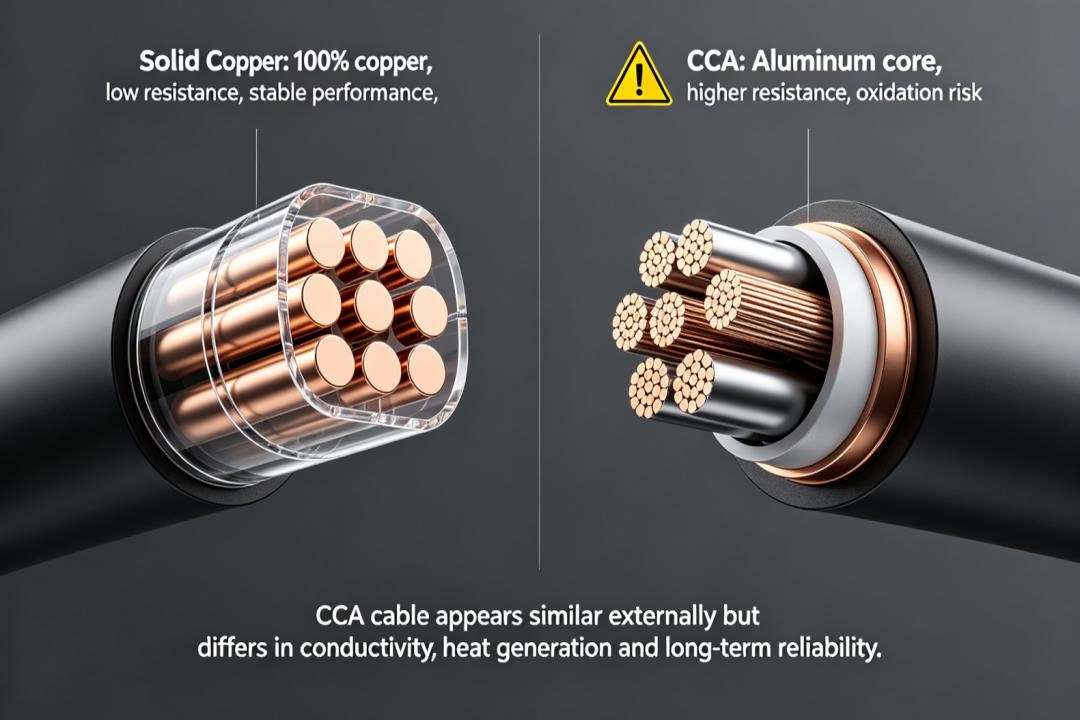
Solid Copper Ethernet Cable Versus Cca (Copper Clad Aluminum) Cable Cross-Section Comparison.
The most significant threat to network performance and safety is not choosing stranded over solid—it is choosing copper-clad aluminum (CCA) over solid copper.
What Is CCA Cable?
CCA cable uses an aluminum core with a thin outer layer of copper. From the outside, CCA cable looks identical to solid copper cable. Even after stripping back the jacket, the difference is not visible to the naked eye. The only way to know is to test the conductor material or trust the manufacturer’s specifications.
Why CCA Is a Problem
CCA cable is not approved for Ethernet networking by any regulatory body. Any claim of compliance is false. Here is why:
1. Higher Electrical Resistance
Aluminum has only about 60% of copper’s conductivity. This means CCA cable has significantly higher resistance than solid copper, which manifests as:
Greater signal attenuation (degradation) over distance
More voltage drop under load
Higher heat generation
2. Fire and Safety Hazards
The National Electrical Code (NEC) does not provide for the use of CCA Ethernet cable in commercial structures. The U.S. Consumer Product Safety Commission found that homes with aluminum wiring are 55 times more likely to have fire hazard conditions than those wired with copper.
CCA cable has approximately 40% higher electrical resistance than solid copper, which causes dangerous overheating under Power over Ethernet (PoE) loads. The lower melting temperature of aluminum compared to copper further increases the risk of flame ignition.
3. Brittleness and Breakage
Aluminum has poor ductility. CCA conductors are brittle and intolerant of bends—merely pulling the cable off the reel or out of the box can break the conductor(s). After termination, the exposed aluminum end oxidizes quickly; unlike copper oxide (which is conductive), aluminum oxide is not, leading to terminations that eventually fail.
4. Not Suitable for PoE
CCA cable is not suitable in any way for Power over Ethernet. Under sustained PoE loads, the conductors heat up, potentially damaging PoE devices or starting a fire.
The Legal Reality
Installations using CCA cable are flatly illegal in many jurisdictions. If an inspector discovers CCA cable in a commercial installation, they may force its removal regardless of any supposed compliance claims printed on the packaging.
Performance Advantages of Solid Copper Ethernet Cable
1. Superior Signal Integrity
Solid copper’s single continuous path experiences less signal attenuation and lower resistance than stranded or CCA alternatives. This results in:
Lower DC resistance for cleaner signal transmission
Reduced crosstalk between pairs
Better performance over longer distances
2. Compliance with Industry Standards
Solid copper Ethernet cable meets or exceeds all major industry standards:
TIA/EIA 568-C.2 and 568-D.2
ISO/IEC 11801
UL 444 and National Electrical Code requirements
IEEE 802.3ab for Gigabit Ethernet
These standards specifically require pure copper conductors for communications cables.
3. Reliable PoE and PoE++ Support
Solid copper’s low resistance means minimal heat buildup even under high-power PoE loads. This makes it the only viable choice for:
PoE (up to 15.4W)
PoE+ (up to 30W)
PoE++ (up to 90W or more)
4. Long-Term Durability
Solid copper stands up to corrosion better than stranded wire, making it ideal for outdoor installations. Its rigid construction holds its shape once routed and resists impact and abrasion.
Applications: Where Solid Copper Excels
Solid copper Ethernet cable is the only acceptable choice for the following applications:
1. In-Wall and Structured Cabling
Once cable disappears behind drywall, replacing it means fishing new lines through studs, ceilings, or conduit all over again. Solid copper’s permanence and reliability make it the obvious choice for permanent infrastructure.
2. Horizontal Cabling (Up to 100 Meters)
TIA/EIA standards require solid conductors for horizontal cabling runs that connect patch panels to wall outlets. Solid copper supports the full 100-meter channel length specified for Ethernet.
3. Data Centers
High-performance data centers rely on solid copper for:
Cat6A 10GBase-T connections
Cat8 25G/40GBase-T deployments
PoE backbones and high-density cabling
4. Power over Ethernet (PoE) Deployments
Security cameras, VoIP phones, wireless access points, and smart building devices all depend on PoE. Solid copper’s low resistance ensures safe, reliable power delivery without overheating.
5. Outdoor and Direct Burial
Solid copper’s corrosion resistance and mechanical durability make it suitable for outdoor installations when paired with appropriate UV-resistant and waterproof jackets.
Choosing the Right Gauge (AWG)
American Wire Gauge (AWG) measures conductor thickness. In Ethernet cables:
Lower AWG number = thicker conductor
23 AWG is thicker than 24 AWG
24 AWG is the most common for Cat5e and Cat6
23 AWG is standard for Cat6A and supports 10G at 100 meters
Key principle: Thicker wire = lower resistance = better for longer runs and PoE
How to Identify Quality Solid Copper Ethernet Cable
1. Check the Specification Sheet
Look for explicit statements:
“100% pure bare copper”
“Solid copper conductors”
“BC” (Bare Copper) or “OFC” (Oxygen-Free Copper)
Avoid cables that list “CCA,” “Copper Clad Aluminum,” or “CCAG” (Copper Clad Aluminum Alloy).
2. Verify Certifications
Quality solid copper cable carries:
UL certification (e.g., UL 444)
ETL verification
Compliance with TIA/EIA standards
3. Request Material Certification
Reputable suppliers can provide documentation confirming conductor material. As one industry guide advises: “Request material certification”.
4. Be Wary of “Too Good to Be True” Prices
CCA cable is significantly cheaper than solid copper. If a price seems unusually low, it likely uses CCA conductors.
Installation Best Practices
Pulling Tension
Solid copper Ethernet cable should be pulled with no more than 25 ft-lbs of force. Exceeding this can damage the conductors.
Termination
Solid conductors are terminated using punch-down blocks or keystone jacks. Unlike stranded cable, solid wire should not be crimped with standard RJ45 plugs for patch cords—the piercing contacts are designed for stranded conductors.
Bend Radius
Avoid sharp bends. Solid copper is rigid and can be damaged by excessive bending.
Frequently Asked Questions
Q: Can I use solid copper Ethernet cable for patch cords?
A: Not recommended. Solid cable is rigid and not designed for repeated flexing. Use stranded cable for patch cords and solid cable for permanent infrastructure.
Q: How far can solid copper Ethernet cable run?
A: Solid copper supports the full 100-meter (328-foot) channel length specified for Ethernet. Cat6A with 23 AWG solid conductors can support 10 Gbps at 100 meters.
Q: Is CCA cable ever acceptable?
A: No. CCA is not approved for Ethernet by any regulatory body, violates the National Electrical Code, and creates fire hazards, especially with PoE.
Q: What’s the difference between 23 AWG and 24 AWG?
A: 23 AWG is thicker, has lower resistance, and performs better over longer distances and with PoE. 24 AWG is thinner and more common in Cat5e and basic Cat6.
Q: How can I tell if my cable is solid copper or CCA?
A: You cannot tell by looking. Check the specification sheet for “100% pure bare copper” or “solid copper conductors.” Avoid any cable that mentions CCA or copper-clad aluminum.
Conclusion
Solid copper Ethernet cable is not a luxury—it is a necessity for any network that demands reliability, performance, and safety. While CCA cables may appear cheaper upfront, they deliver inferior performance, violate industry standards, create fire hazards, and ultimately cost more in rework, downtime, and replacement.
For permanent installations, in-wall cabling, PoE deployments, and any application where reliability matters, solid copper is the only choice that makes sense. The extra upfront cost is negligible compared to the consequences of failure.
When you choose solid copper Ethernet cable, you are not just buying wire—you are investing in a network that will perform reliably for decades to come.
References
National Electrical Code (NEC) – Article 800 Communications Cables
TIA/EIA 568-C.2 and 568-D.2 – Commercial Building Telecommunications Cabling Standards
UL 444 – Standard for Communications Cables
ISO/IEC 11801 – Information Technology – Generic Cabling for Customer Premises
U.S. Consumer Product Safety Commission – Aluminum Wiring Hazard Reports
Various industry resources including trueCABLE, Optcore, L-com, StarTech, and MakeUseOf
This guide is for informational purposes only. Always consult the latest codes and standards and work with qualified professionals for network installations.