 Minxing Cable
 Jinhuanyu Cable
 Jinlongyu Cable
 Guangdong Cable
 Zhujiang Wire & Cable




Introduction
Every time you stream a video, send an email, or ask an AI chatbot a question, your data travels through miles of copper cable. Not fibre optics. Not wireless. Copper.
The global copper wire and cable market was valued at USD 182.0 billion in 2025 and is projected to reach USD 324.7 billion by 2032, growing at a compound annual growth rate (CAGR) of 8.6%. Within this vast market, one segment is experiencing particularly explosive growth: active copper cables (ACC) .
The global active copper cables market was valued at approximately USD 2.1 billion in 2024 and is expected to reach USD 3.8 billion by 2031, growing at a CAGR of 7.8%. The DAC (Direct Attach Copper) active copper cable market alone was valued at USD 1.102 billion in 2025 and is forecast to reach USD 1.859 billion by 2032, with a CAGR of 7.3%.
Why is this happening? And why should you care?
This article explores the active copper cable market—what it is, why it is growing so rapidly, and what the future holds for this critical but often overlooked technology.
What Is an Active Copper Cable?
Before we dive into the numbers, let us establish what an active copper cable actually is.
An Active Copper Cable (ACC) is a high-speed copper-based interconnect solution that integrates active signal conditioning components—such as retimers, equalizers, or driver ICs—into traditional copper cables.
This is a critical distinction from passive copper cables. Passive cables simply transmit signals without any active electronics. They work well for short distances and lower speeds. But as data rates climb into the hundreds of gigabits per second, passive cables face a fundamental problem: signal attenuation.
At high speeds, electrical signals degrade rapidly over copper. Crosstalk between adjacent wires increases. Bit error rates rise. Passive cables simply cannot maintain signal integrity at 400G, 800G, or beyond.
Active copper cables solve this problem by embedding electronics that compensate for signal attenuation and crosstalk in copper media, enabling higher data rates and longer reach while maintaining the advantages of copper: low latency, low power consumption, and cost efficiency.
Active Copper Cable vs. Passive DAC vs. AOC vs. AEC
To understand the ACC market, it helps to understand where it fits in the connectivity ecosystem:
| Technology | Active Electronics? | Max Reach | Power Consumption | Cost | Primary Use Case |
|---|---|---|---|---|---|
| Passive DAC | No | 2-3m | Lowest | Lowest | Intra-rack connections |
| Active Copper Cable (ACC) | Yes (retimers, equalizers) | 5-7m | Low | Low | Intra-rack, short inter-rack |
| Active Electrical Cable (AEC) | Yes (retimers) | 7-10m | Medium | Medium | Inter-rack connections |
| Active Optical Cable (AOC) | Yes (optical transceivers) | 100m+ | High | High | Long-reach inter-rack |
Active copper cables occupy a sweet spot: longer reach than passive DACs, lower cost and power than AOCs, and comparable performance to AECs at a lower price point. This makes them particularly attractive for high-bandwidth links in the 2–5 metre range.
The Numbers That Matter: Market Size and Growth
The Broad Market
The global active copper cables market is experiencing significant growth, driven by increasing demand for high-speed data transmission in telecommunications, IT, and healthcare.
2024 value: USD 2.1 billion
2031 forecast: USD 3.8 billion
CAGR: 7.8%
The DAC Segment
Within the broader ACC market, the Direct Attach Copper (DAC) segment is a key growth driver.
2025 value: USD 1.102 billion
2032 forecast: USD 1.859 billion
CAGR: 7.3%
2025 production: approximately 15.3 million units
Average selling price: approximately USD 70 per unit
Production capacity: approximately 16 million units
Gross profit margin: 20%–40%
The 800G High-Speed Segment
The highest-growth segment is 800G high-speed active copper cables.
2024 value: USD 935.9 million
2025 forecast: USD 1.023 billion
2035 forecast: USD 2.5 billion
CAGR: 9.3%
The Wider Copper Cable Market
To put these numbers in context, the broader copper wire and cable market is massive:
2025 value: USD 182.0 billion
2032 forecast: USD 324.7 billion
CAGR: 8.6%
The Growth Drivers: Why Active Copper Cables Are Booming
1. The AI Data Center Explosion
The single biggest driver of the active copper cable market is the explosive growth of AI data centres.
AI workloads are massively compute-intensive. They require thousands of GPUs working in parallel, all communicating with each other at extremely high speeds. The training of large language models (LLMs) like GPT-4, Claude, and Gemini requires clusters of tens of thousands of GPUs, all connected in a high-speed fabric.
These clusters generate enormous bandwidth requirements. The connections between GPUs, between GPUs and switches, and between switches and storage must operate at 400G, 800G, and soon 1.6T.
Passive DACs simply cannot handle these speeds over the required distances. Active copper cables can.
According to industry analysis, the medium-term AI outlook is strong, with active cables expected to extend copper’s viability into 448G, delaying the transition to optics or co-packaged optics (CPO).
2. High-Speed Ethernet Upgrades
Data centres are rapidly upgrading from 100G and 400G to 800G and 1.6T Ethernet. As the deployment of 400G and 800G ports accelerates, passive DACs face limitations in reach and signal integrity, positioning active copper cables as a critical short-reach interconnect option.
3. Increasing Compute Density
Cloud data centres are becoming denser. More servers, more GPUs, more storage devices are packed into the same physical space. This increases the number of interconnects required and the speed at which they must operate.
Active copper cables provide a low-power, low-total-cost-of-ownership (TCO) solution for these dense environments.
4. Cost and Power Advantages
Active copper cables offer clear advantages over alternatives:
Compared to AOCs: ACCs are significantly cheaper and consume less power
Compared to AECs: ACCs are simpler to deploy and often more cost-effective for shorter reaches
Compared to passive DACs: ACCs support higher speeds and longer reaches
5. Telecommunications and 5G
Beyond data centres, the telecommunications sector is a major consumer of active copper cables. The rollout of 5G networks, the expansion of broadband infrastructure, and the growth of IoT all require reliable, high-speed copper cabling.
Key Players in the Active Copper Cable Market
The active copper cable market features a mix of established cable manufacturers, component suppliers, and specialised interconnect companies.
Major Players in the ACC Market
According to industry reports, key players in the global Active Copper Cable (ACC) market include:
Broadex Technologies
Sanwa Denki Kogyo
MultiLane
PhotonIC Technologies
BizLink
Dell
Optec
Kordz
TE Connectivity
Advanced-Connectek
Mo-Link Technologies
LinkX
ETU
Major Players in the Data Center ACC Segment
For data centre-specific active copper cables, key players include:
MACOM
Semtech
Spectra7
I-PEX
Foxconn Interconnect Technology (FIT)
Major Players in the 800G Segment
For the high-growth 800G segment, key players include:
Amphenol Corporation
TE Connectivity
Molex
3M Company
Belden
Furukawa Electric
CommScope
Corning
Nexans
Prysmian Group
Siemon
Recent Developments
The market is seeing significant strategic activity:
TE Connectivity announced in March 2025 a strategic partnership with Belden to co-develop and market 800G high-speed active copper cable assemblies for data centres.
Furukawa Electric launched its 800G High-Speed Active Copper Cable portfolio in December 2024.
CommScope secured a major contract in June 2025 to supply 800G ACC cable assemblies to a leading hyperscale cloud operator.
Frequently Asked Questions
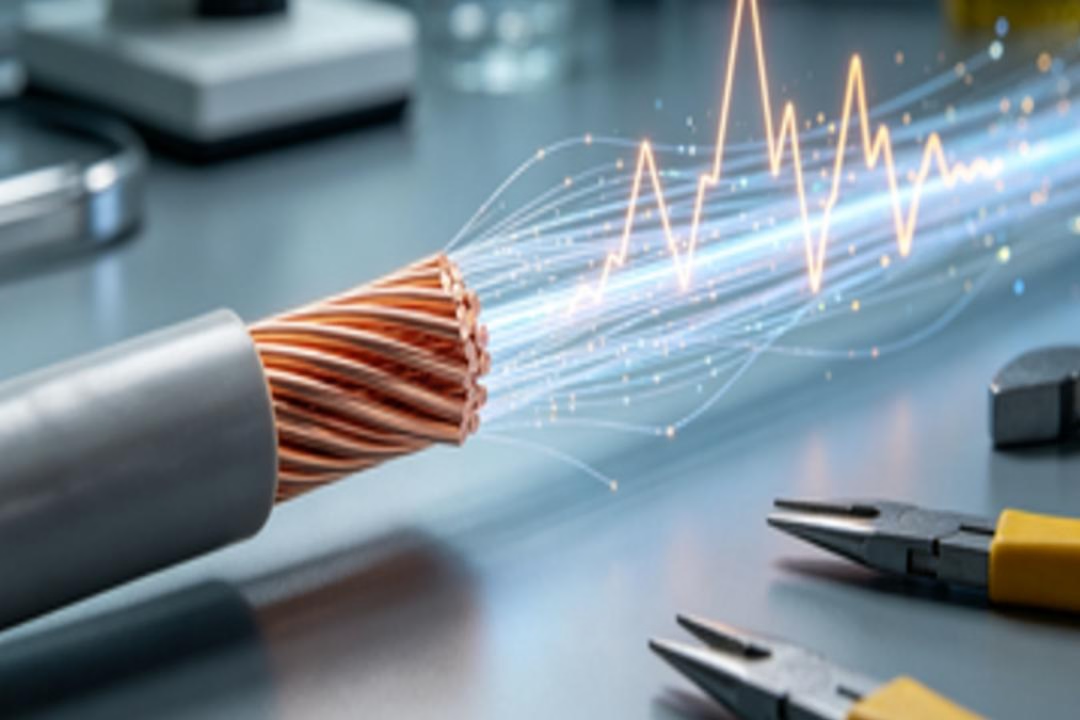
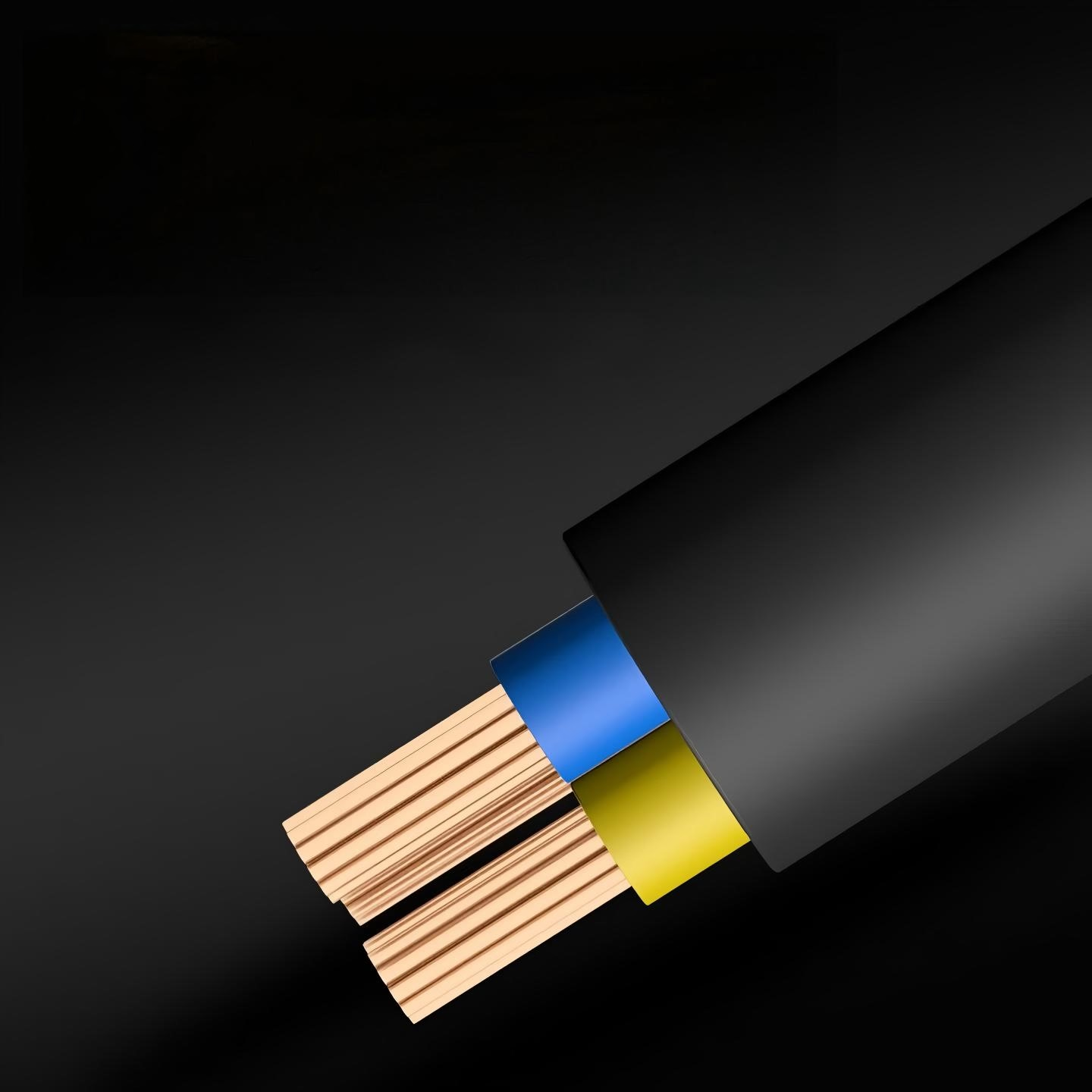
Laboratory Technical Illustration Of Stranded Copper Cable. Light Waveform Graphics Visualize High-Speed Data Signals Transmitted Through The Copper Conductor. Active Signal Equalization And Retiming Technology Compensates Signal Attenuation, Enabling Reliable High-Speed Interconnection For Data Centre Applications.
Q: What is the difference between an active copper cable and a passive copper cable?
A: ACC integrate active signal conditioning components—retimers, equalisers, or driver ICs—to compensate for signal attenuation and crosstalk. Passive copper cables have no active electronics and are limited to shorter distances and lower speeds.
Q: What is the market size of the active copper cable market?
A: The global active copper cables market was valued at approximately USD 2.1 billion in 2024 and is expected to reach USD 3.8 billion by 2031, growing at a CAGR of 7.8%.
Q: What is driving the growth of the active copper cable market?
A: The primary drivers are the expansion of AI data centres, upgrades to high-speed Ethernet (400G/800G), increasing compute density in cloud data centres, and the cost and power advantages of active copper cables over alternatives.
Q: Who are the key players in the active copper cable market?
A: Key players include Broadex Technologies, Sanwa Denki Kogyo, MultiLane, PhotonIC Technologies, BizLink, TE Connectivity, Amphenol, Molex, Belden, and CommScope.
Q: What is the outlook for the 800G active copper cable segment?
A: The 800G high-speed active copper cable market is expected to grow from USD 1.023 billion in 2025 to USD 2.5 billion by 2035, at a CAGR of 9.3%.
Q: Where can I find official market data for active copper cables?
A: Official market data is available from research firms including Global Info Research, LP Information, 6Wresearch, and MarketsandMarkets. Search Google for “Global DAC Active Copper Cable Market Report 2025” or “ACC Market Size 2025” to find detailed reports.
Conclusion
The active copper cable market is a critical but often overlooked component of the global technology infrastructure. While fibre optics grab the headlines, it is copper that does the heavy lifting inside the world’s data centres, connecting the GPUs that power AI, the servers that run the cloud, and the switches that route the internet.
The numbers tell the story:
USD 2.1 billion market in 2024
USD 3.8 billion by 2031
7.8% CAGR
USD 1.859 billion DAC segment by 2032
USD 2.5 billion 800G segment by 2035
Active copper cables are not a legacy technology waiting to be replaced. They are a living, evolving technology that is adapting to meet the demands of the AI era. With the ability to extend copper’s viability into 448G and beyond, they will remain a critical part of the data centre interconnect ecosystem for years to come.
When you choose active copper cables, you are choosing the sweet spot of performance, cost, and power efficiency—the unsung hero that makes the AI revolution possible.
References
Global Info Research – Global DAC Active Copper Cable Market Report 2026
LP Information – Global Active Copper Cable (ACC) Market Growth 2026-2032
6Wresearch – Global Active Copper Cables Market (2025-2031)
MarketsandMarkets – Copper Wire & Cable Market Report 2025-2032
WiseGuy Reports – 800G High-Speed Active Copper Cable Market
Various industry sources including LightCounting, Passive Components Europe, and FS.com
This guide is for informational purposes only. Market data is based on publicly available reports and forecasts. Actual market conditions may vary.