 Minxing Cable
 Jinhuanyu Cable
 Jinlongyu Cable
 Guangdong Cable
 Zhujiang Wire & Cable





Introduction
That subtle veil over your favorite jazz recording. The missing harmonic richness in a symphony’s climax. The vague sense that your system could sound better, but you are not quite sure why.
Most audiophiles obsess over speakers, amplifiers, and source components—and rightly so. Yet one of the most critical links in the audio chain is often the most overlooked: the RCA interconnect cable connecting your source to your amplifier.
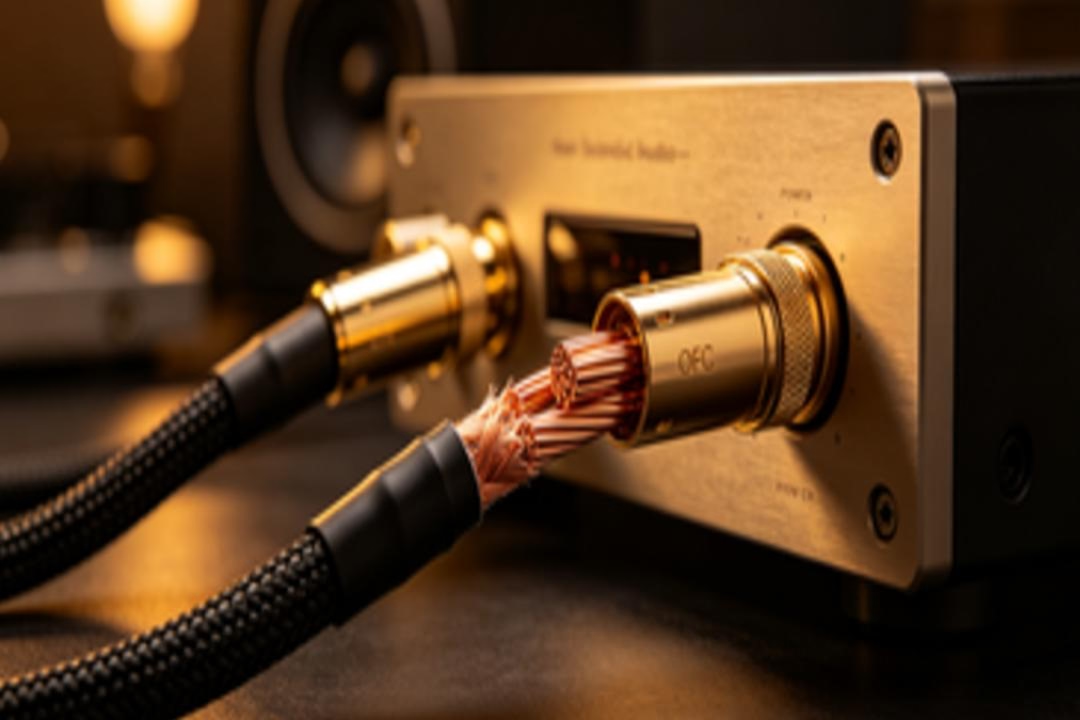
Enter Oxygen Free Copper (OFC) RCA cable—a conductor technology that has been transforming audio systems since its development in Japan around 1975. While skeptics dismiss it as marketing hype, the physics behind Oxygen Free Copper Rca Cable tells a different story.
This comprehensive guide explores the science, the sonic benefits, and the practical considerations of Oxygen Free Copper Rca Cables, helping you understand whether they are the right upgrade for your system.
What Is Oxygen Free Copper (OFC)?
Oxygen Free Copper (OFC) is a high-purity copper from which oxygen molecules have been removed through a specialized extrusion process performed in an oxygen-free inert-gas atmosphere. The result is copper with an oxygen content of approximately 10–50 parts per million (ppm) , compared to 250–500 ppm in standard Electrolytic-Tough-Pitch (ETP) copper.
This difference might seem trivial, but it has profound implications for audio signal transmission.
The Grain Boundary Problem
Standard copper is polycrystalline—composed of many small crystal grains. The points where these grains meet are called grain boundaries. In a conductor, these crystal boundaries act as non-linear resistance to the flow of electric current. As a signal travels through the conductor, it must cross these boundaries, and each crossing introduces a tiny amount of distortion.
Standard copper has approximately 1,500 grains per foot. OFC reduces this significantly, and more advanced processes like Ohno Continuous Cast (OCC) copper can achieve a single crystal over hundreds of feet.
The Oxide Problem
When copper is exposed to air, it oxidizes. Copper oxide is a poor conductor. Over time, oxidation can degrade the copper’s physical structure and sound quality. By reducing the oxygen content from the start, OFC retards the formation of copper oxides, ensuring the conductor remains cleaner and more conductive over its lifetime.
Reason 1: Superior Conductivity for Cleaner Signal Transmission

Abstract Tech Visualization Comparing Audio Waveform Transmission. Smooth, Undistorted Waveforms Represent Clean Signal Transfer Achieved By High-Purity Ofc Copper, While Signal Degradation And Distortion Occur In Lower-Grade Conductors.
The primary advantage of OFC is its enhanced conductivity. While standard ETP copper has a conductivity of approximately 100% IACS (International Annealed Copper Standard), high-purity OFC can achieve 101% IACS or higher.
This improvement translates directly to lower electrical resistance. Lower resistance means less signal attenuation—more of the audio signal reaches your amplifier intact. The difference in conductivity between OFC and standard copper is typically 0.5% to 2%.
In the context of an audio system, this manifests as:
Tighter, more controlled bass with better transient response
Extended high frequencies with greater air and sparkle
Improved micro-dynamics—the subtle volume changes that give music its emotional power
As Atlas Cables explains: “High purity conductors sound clearer than their unprocessed (TPC) counterparts because there are fewer crystal boundaries present to cause signal degradation”.
Reason 2: Reduced Oxidation for Long-Term Reliability
Perhaps the most compelling advantage of OFC is its resistance to oxidation.
Standard copper contains oxygen impurities that can react over time, forming copper oxide within the conductor structure. This oxide is not only a poor conductor but can actually interrupt the copper’s physical structure, degrading sound quality.
OFC, with its dramatically reduced oxygen content, is less prone to oxidation. This means:
Consistent performance over the life of the cable
No degradation of sound quality as the cable ages
Longer cable lifespan with fewer replacement cycles
As one industry expert notes: “OFC is more to do with capability to avoid corrosion rather than conductivity. Corroded copper—i.e. copper oxide—is a bad conductor”.
This long-term reliability is particularly important for systems where cables are installed in hard-to-reach locations or where frequent replacement is impractical.
Reason 3: OFC vs. CCA—The Real Comparison
While the debate between Oxygen Free Copper Rca Cable and standard copper continues, there is no debate when it comes to copper-clad aluminum (CCA).
CCA cables use an aluminum core with a thin copper coating. They are cheaper to manufacture and lighter, but they are vastly inferior in every performance metric.
The Problems with CCA
Higher resistance: Aluminum has only about 61% of copper’s conductivity
Greater signal loss: More of the audio signal is lost as heat
Oxidation issues: Aluminum oxide is non-conductive and can compromise connections
Brittleness: Aluminum is more prone to breaking under stress
As the audio community repeatedly emphasizes: “Get oxygen free copper if it is available as that will be a pure copper conductor. Don’t bother with copper clad aluminum if it is offered”.
Many budget RCA cables on the market use CCA, which is why they fail to deliver the performance that quality audio systems deserve. Professional buyers strictly reject CCA due to its high resistance, weak tensile strength, and quick oxidation.
Reason 4: Superior Shielding and Noise Rejection
An OFC RCA cable is more than just its conductor. Premium OFC RCA cables incorporate advanced shielding to protect the delicate audio signal from electromagnetic interference (EMI) and radio-frequency interference (RFI).
Multi-Layer Shielding
High-quality Oxygen Free Copper Rca Cables typically feature:
Foil shielding to block high-frequency interference
OFC braided shielding for low-frequency noise rejection
Twisted pair construction to cancel out induced noise
For example, the SVS SoundPath RCA cable uses “a directional shield layer with a spiral braid of premium grade aluminum foil and 56 strands of 99.99% OFC tinned copper shielding”.
RECOIL’s RCA cables utilize “100% Oxygen Free Copper (OFC) and a dedicated twisted pair design to actively suppress noise before it reaches your amp”.
What This Means for Your System
Effective shielding translates to:
Blacker backgrounds between notes
No hum or buzz from nearby power cables or electronic devices
Greater detail retrieval as the signal is not masked by noise
Wider soundstage with better instrument separation
Reason 5: The Audiophile Consensus—Real-World Benefits
While skeptics often dismiss OFC as marketing hype, the audiophile community has reached a broad consensus: OFC is the industry standard for quality audio cables.
What Listeners Report
Users consistently report improvements when upgrading to OFC RCA cables:
“The quality feels solid, the connectors fit tight, and the noise reduction is legit — no buzzing or interference at all”
“99.99% oxygen-free copper for excellent sound quality”
“Pure Sound: It uses 99.99% oxygen-free copper”
The Value Proposition
OFC RCA cables offer an exceptional value proposition:
Affordable: OFC is significantly less expensive than silver or OCC copper cables
Effective: OFC delivers measurable performance improvements over standard copper
Durable: OFC’s oxidation resistance ensures long-term reliability
As one industry observer notes: “Copper offers the best material for affordable cables, as well as a significant level of performance in superior electromagnetic designs”.
The Science of Sound: Why Conductor Material Matters
Resistance, Capacitance, and Inductance
Every cable has three fundamental electrical properties: resistance (R) , capacitance (C) , and inductance (L) . These properties interact with your audio equipment to shape the sound.
OFC’s lower resistance means less of the signal is lost as heat. Lower capacitance means the cable is less likely to roll off high frequencies. Lower inductance means better transient response.
Grain Boundaries and Signal Degradation
At the microscopic level, the grain boundaries in standard copper act as tiny diodes that can distort the audio signal. OFC’s reduced grain boundaries mean fewer opportunities for distortion.
How to Choose the Right OFC RCA Cable
1. Check the Purity
Look for cables specifying 99.99% oxygen-free copper or higher. This ensures you are getting genuine Oxygen Free Copper Rca Cable, not a lower-grade alternative.
2. Examine the Shielding
Quality OFC RCA cables use multi-layer shielding: foil, braided copper, or both. This protects the signal from EMI and RFI.
3. Inspect the Connectors
Look for gold-plated connectors. Gold does not oxidize, ensuring a clean, reliable connection over time.
4. Consider the Construction
Twisted pair construction helps cancel out induced noise. Solid conductors offer lower resistance, while stranded conductors offer greater flexibility.
5. Avoid CCA at All Costs
If a cable does not specify 100% copper, assume it is CCA and avoid it. As one expert bluntly states: “You do NOT want CCA or Copper Clad Aluminum wire”.
Frequently Asked Questions
Q: What is the difference between OFC and standard copper?
A: OFC has significantly lower oxygen content (10–50 ppm vs. 250–500 ppm), resulting in higher conductivity, reduced oxidation, and fewer grain boundaries that can degrade the audio signal.
Q: Is OFC worth the extra cost?
A: For most audio systems, yes. The improved conductivity, reduced oxidation, and superior shielding of Oxygen Free Copper Rca Cables deliver tangible improvements in sound quality and long-term reliability.
Q: Is there a noticeable difference between OFC and standard copper RCA cables?
A: Many listeners report clearer sound, better bass definition, and improved high-frequency extension. The difference is most noticeable in high-resolution systems.
Q: What is the difference between OFC and OCC copper?
A: OCC (Ohno Continuous Cast) copper is a more advanced process that produces a single-crystal structure with even fewer grain boundaries. OCC is more expensive and typically found in ultra-high-end cables.
Q: Should I choose OFC or silver RCA cables?
A: Silver offers slightly higher conductivity (about 7% more), but is significantly more expensive. Oxygen Free Copper Rca Cable offers excellent performance at a much more accessible price point.
Q: Can I hear the difference between OFC and CCA cables?
A: Yes. CCA’s higher resistance and susceptibility to oxidation result in greater signal loss and degradation over time. The audio community strongly recommends OFC over CCA.
Q: Where can I find more information about audio cable materials?
A: Search Google for “audio cable conductor materials” or “OFC vs OCC copper” for numerous resources from engineering reference sites, audio forums, and manufacturer technical documents.
Conclusion
Oxygen Free Copper RCA cables represent a meaningful upgrade for any audio system. The science is clear: OFC’s reduced oxygen content, enhanced conductivity, and superior oxidation resistance translate to cleaner signal transmission, greater detail retrieval, and long-term reliability.
While skeptics may dismiss it as marketing hype, the physics of electrical conductivity and grain boundary distortion are well-established. Oxygen Free Copper Rca Cable is not about magic—it is about better engineering.
When you choose an Oxygen Free Copper Rca Cable , you are choosing:
Superior conductivity for cleaner signal transmission
Reduced oxidation for consistent performance over time
Superior shielding for noise-free audio
Long-term reliability for years of listening enjoyment
Exceptional value compared to silver or OCC alternatives
For the cost of a few good albums, you can upgrade the most overlooked link in your audio chain and rediscover the music you love. The veil will lift. The harmonic richness will return. And you will finally hear what your system is capable of.
References
Atlas Cables – Conductor Technology Overview
The Absolute Sound – Cable and Interconnect Construction
PS Audio – Cables: RCA Interconnects
Audiomica – OCC Copper vs OFC vs Silver
Various industry resources including Monoprice, RECOIL, SVS, and audio community forums
This guide is for informational purposes only. Always audition cables in your own system when possible, as room acoustics and system synergy can affect perceived performance.